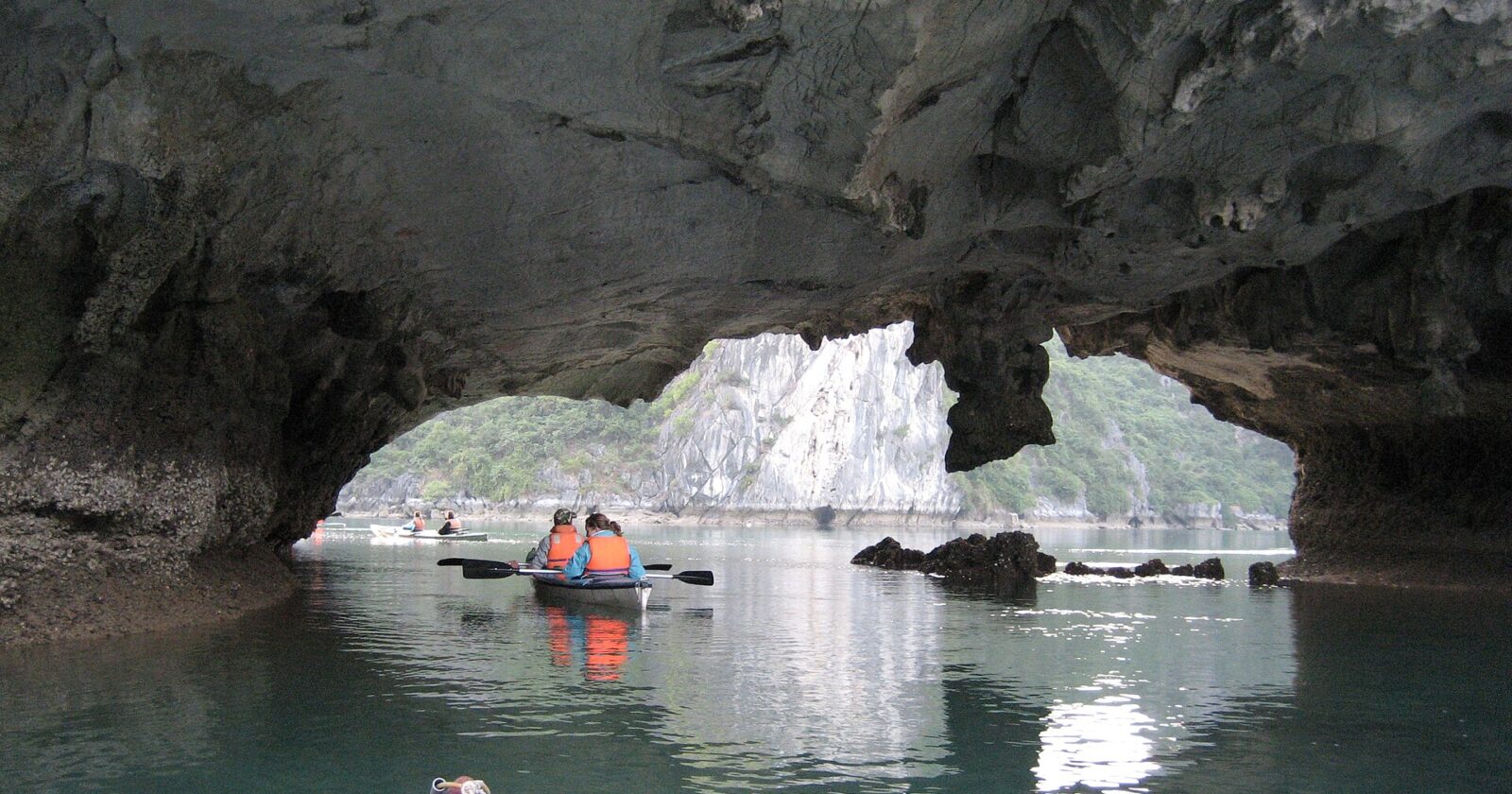
The arch into Luon Cave is low enough that the women rowing the bamboo boats duck as they pass under it, and kayakers lean back and let the boat drift. Inside the tunnel the light goes green, the noise from the boats outside drops away, and then you come out into a lagoon walled in on every side by cliffs, with macaques sometimes watching from the rocks. It takes a few minutes, and for many people it’s the moment they remember from the whole trip. Halong Bay kayaking is mostly short sessions like this at a handful of set spots, but the right one, at the right time of day, is the best thing on the programme.
This page covers both halves of what you’ll actually do off the boat: the paddling and the caves. It explains where kayaking is allowed, what a session is like, and why Lan Ha is better for it. It covers the walk-through caves worth your time, Sung Sot above all, and the ones you can skip, then shows which cruises and routes include what, so you can check an itinerary before you book. Prices were checked in October 2026; treat them as the right order of magnitude rather than a quote. For the wider picture, start with our complete Ha Long Bay guide.
The Caves and Paddling Spots at a Glance
| Place | Where | How you visit | Verdict |
|---|---|---|---|
| Sung Sot Cave | Ha Long, Route 2 | On foot, up a stone staircase | A major cave on Route 2 |
| Luon Cave | Ha Long, Route 2 | Kayak or bamboo boat | A short paddle under the arch |
| Thien Cung Cave | Ha Long, Route 1 | On foot | Ornate; less essential if you’ve seen Sung Sot |
| Dau Go Cave | Ha Long, Route 1 | On foot | Plainer, with a good story |
| Cua Van | Ha Long, Route 3 | Rowing boat or kayak | A former floating village, not a cave |
| Dark and Bright Cave | Lan Ha | Kayak or bamboo boat | A cave paddled by kayak or bamboo boat |
| Thien Canh Son Cave | Bai Tu Long | On foot | A cave stop on Bai Tu Long itineraries |
| Vung Vieng and Cong Do | Bai Tu Long | Rowing boat or kayak | Kayaking areas in Bai Tu Long Bay |
How Kayaking Works on a Cruise
You can’t simply launch a kayak wherever you like. In Ha Long and Bai Tu Long, kayaking is allowed only in a set of designated areas, and the boats take you to them. The ones that come up most often are Luon Cave, Ba Hang, the Cua Van and Vung Vieng floating villages, Trinh Nu Cave, the Cong Do area and the pearl-farm area at Tung Sau. Kayaks aren’t allowed inside the big walk-through caves such as Sung Sot and Thien Cung.
A typical session goes like this. The boat anchors near the kayaking point, or the tender takes you to a floating platform where the kayaks are kept. You’re given a life jacket, which you wear the whole time, and a stable, sit-on-top plastic kayak, usually a two-seater. A guide gives a short briefing and paddles with the group or watches from a small boat. How long a session lasts depends on your itinerary, so ask the crew. No experience is needed; if you can sit up and move a paddle, you’ll be fine.
What it costs
Whether kayaking is included depends on the operator; Indochina Junk, for one, includes it in its itineraries. Some budget boats charge for it on the day, typically US$10–15 per person. At the official points, kayaking and rowing also carry service charges that vary by place: the Ha Long Bay Management Board lists Luon Cave kayaking at 50,000 VND (about US$2) per trip for two people and rowing at 30,000 VND (about US$1) per person per trip. If kayaking matters to you, check the inclusions list and ask how long the session lasts. Forty-five minutes on the water is a good session; twenty after a queue isn’t.
Kayak or bamboo boat?
At most points you can choose between paddling yourself and being rowed in a bamboo boat, usually by a woman from the local fishing community. Neither is the “wrong” choice.
- Take a kayak if you want to set your own pace, get close to the cliffs and have a bit of exercise. It’s the more memorable experience for most people.
- Take a bamboo boat if you’re travelling with small children, older relatives or anyone nervous on the water, if you want both hands free for a camera, or if you’d simply rather look than paddle. You sit low on the water, it’s quieter, and the rower knows the currents.
Many visitors leave the bamboo-boat rower a small tip in dong. It’s appreciated rather than expected.
Luon Cave: The Best Short Paddle in Ha Long
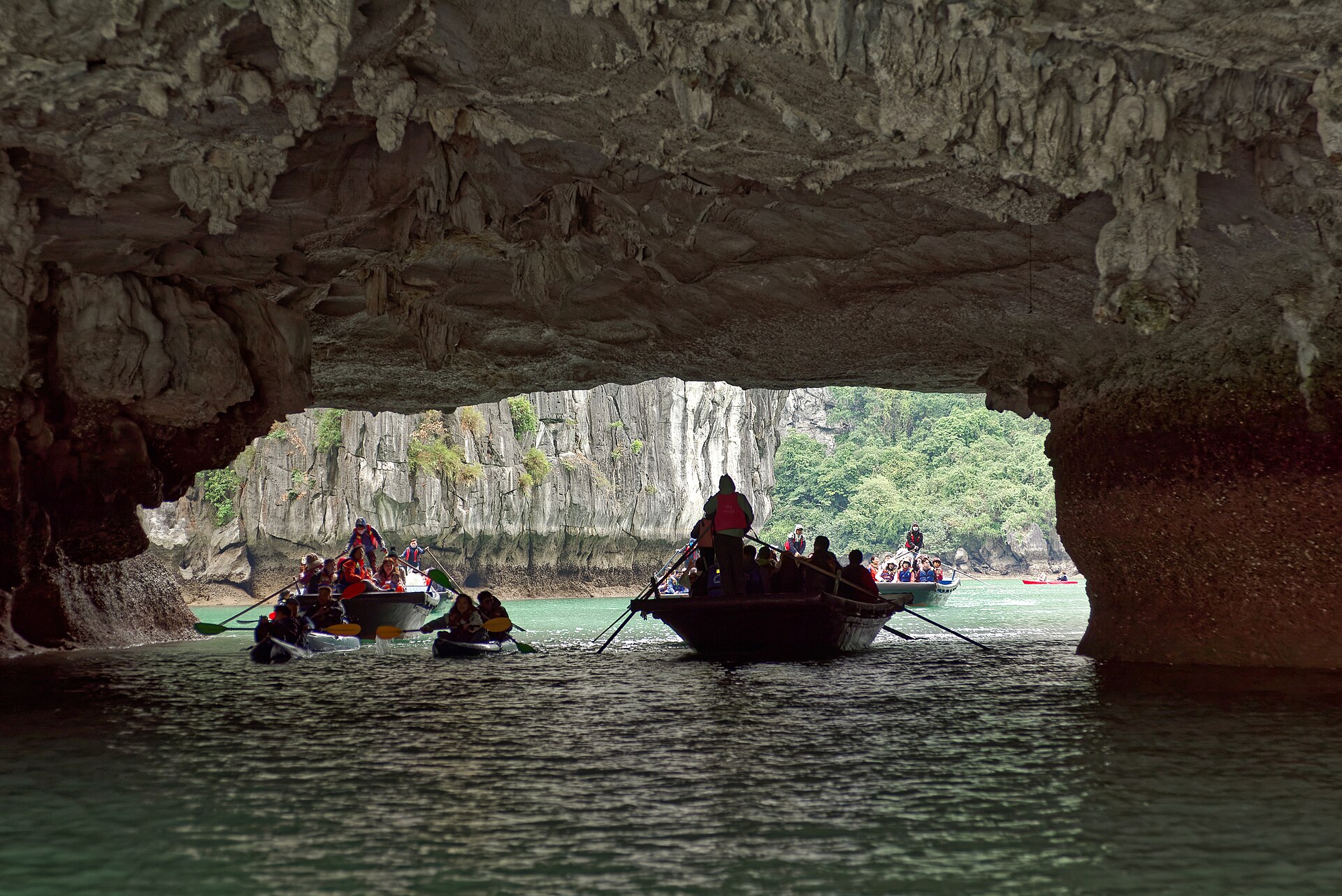
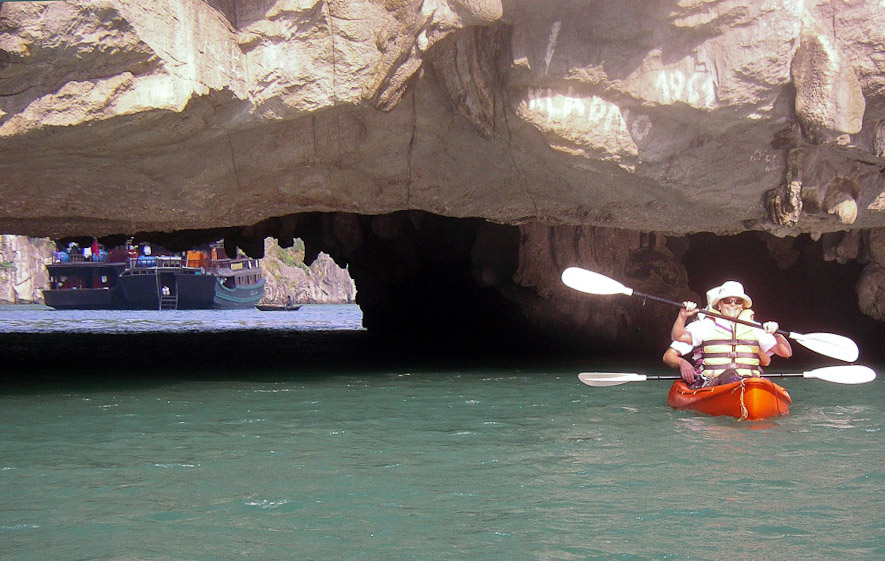
Luon isn’t really a cave. It’s a tunnel through the side of Bo Hon island, the same island as Sung Sot, leading into a lagoon enclosed by cliffs on every side. You pass through by kayak or bamboo boat, and on the far side the water is sheltered and still, with forest hanging off the rock walls. Macaques sometimes come down to the water’s edge. Don’t feed them, and keep a hand on anything loose.
Its one drawback is popularity. Luon is on Route 2, the most popular of Ha Long’s routes, so boats can queue at the arch in both directions. Ask your crew when your itinerary reaches it.
Lan Ha: Where the Kayaking Is Best
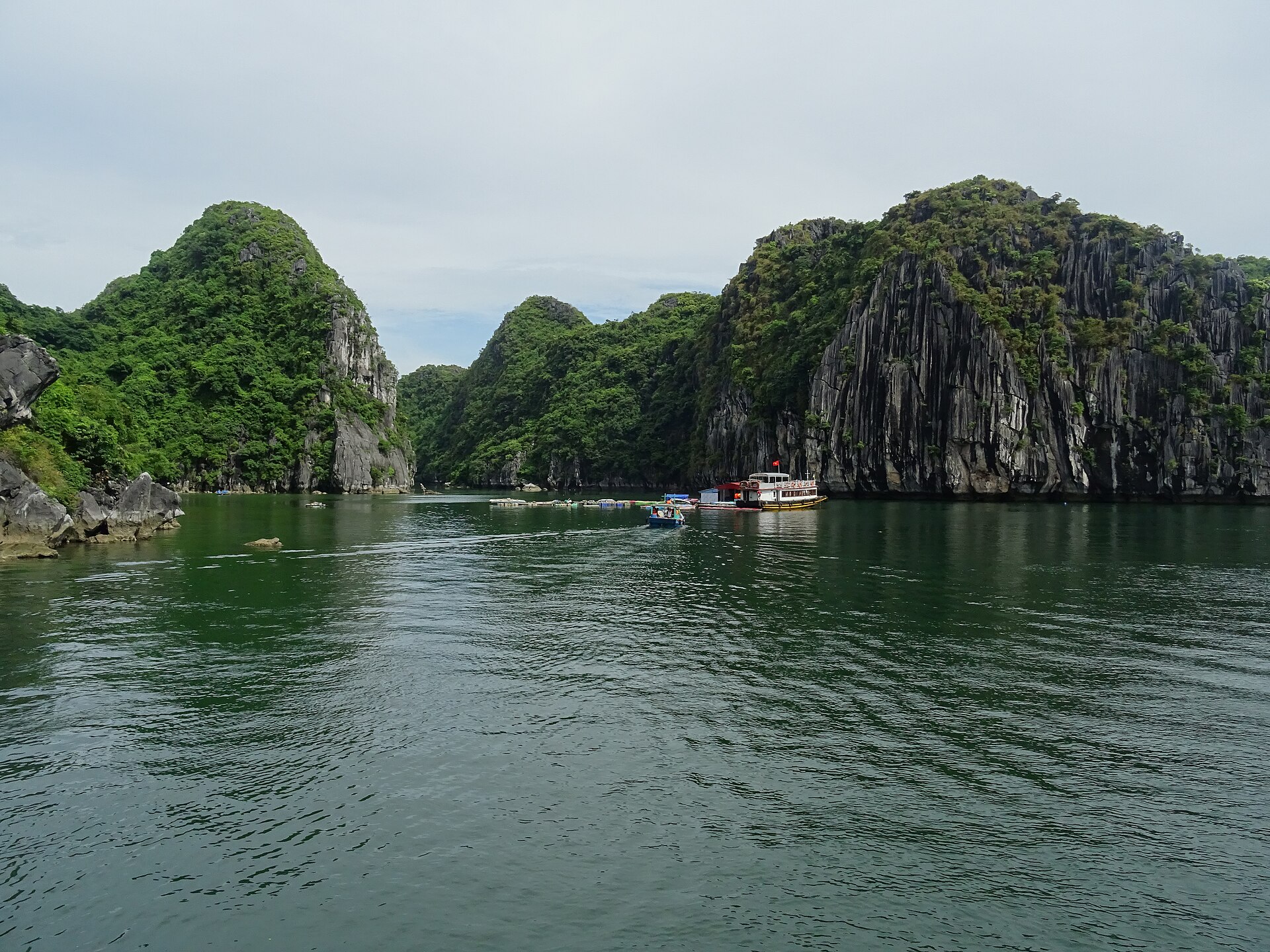
If kayaking is a priority, the honest advice is to go to Lan Ha, off Cat Ba island. Lan Ha itineraries treat paddling as the main event rather than a stop on the way to a cave. Paradise Vietnam’s two-day Lan Ha cruise, for example, includes a kayak or bamboo-boat cave excursion from 07:30 to 08:30.
The best known is the Dark and Bright Cave, near the border with Ha Long and close to Cat Ba National Park. It’s a pair of tunnels through a limestone island into a lagoon, reachable only by kayak or bamboo boat. The dark section is low and is easier to pass when the tide is out, so the crew will time the visit accordingly. Other favourite spots include the lagoons around Tra Bau, and most Lan Ha days add a swim from a small beach such as Ba Trai Dao or Van Boi.
You can paddle Lan Ha on an overnight cruise, or base yourself on Cat Ba and take a day boat, which Halong Tour and Transport Service lists from US$25 per person in a group of 16 to 25 (US$39 for one to five). Our Lan Ha vs Ha Long comparison explains the trade-offs, and our Cat Ba Island guide covers staying on the island.
Bai Tu Long: The Quietest Water
North-east of Ha Long, Bai Tu Long has the fewest boats of the three bays, and its paddling reflects that. The usual spots are around the floating villages of Vung Vieng and Cong Dam and the Cong Do area, where you can kayak along the cliffs with little company, or take a rowing boat through the village itself. It’s the choice for anyone who wants the scenery in near silence. See our Bai Tu Long Bay guide for more.
The Walk-Through Caves
The bay’s islands are riddled with caves, but only a few are open to visitors, and they’re the ones every boat on a route goes to. Here’s what they’re like, and which deserve your time.
Sung Sot Cave
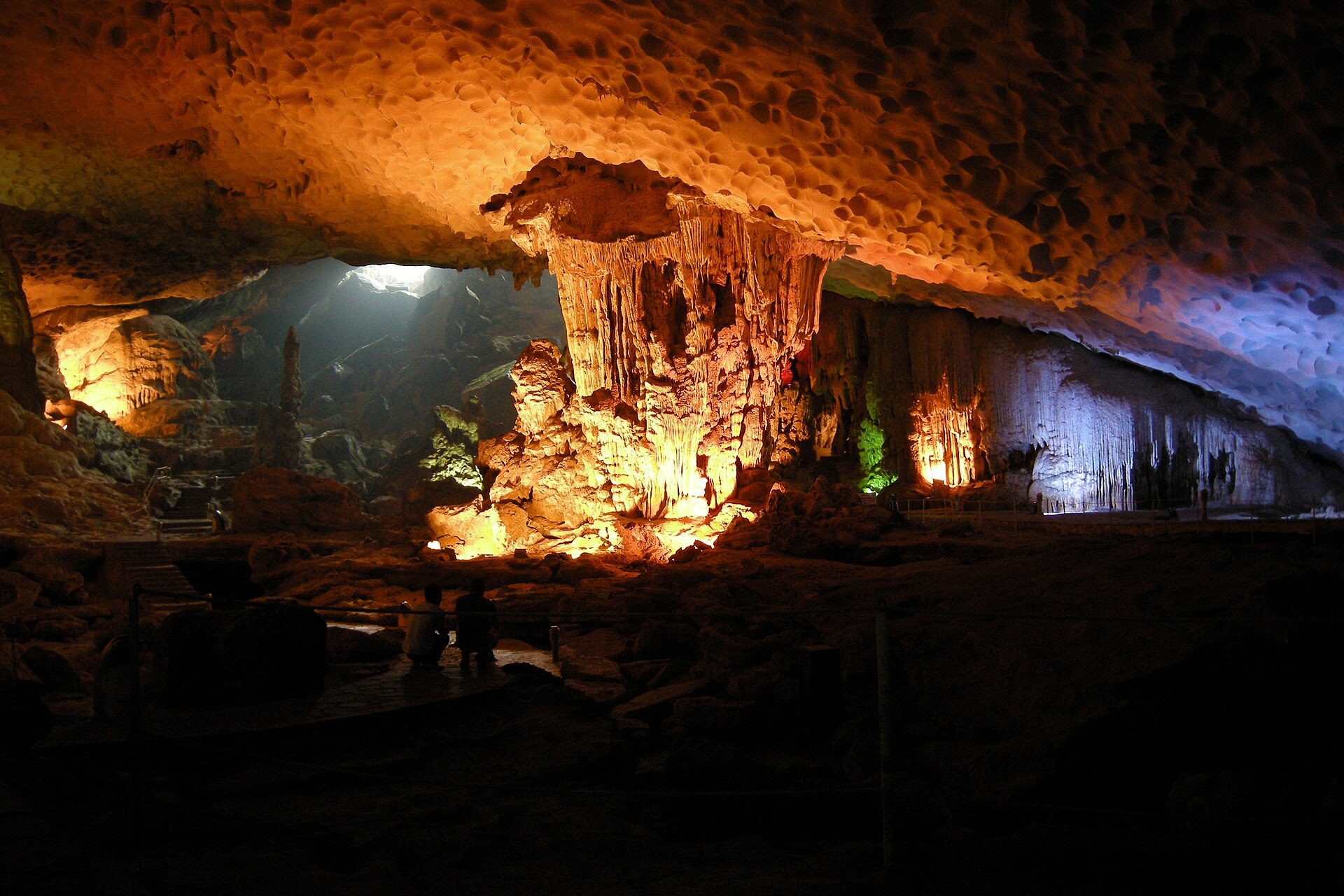
Sung Sot, on Bo Hon island, is a major cave attraction on Route 2. French explorers named it the “Grotte des Surprises” in 1901, and the surprise is still there. You climb a stone staircase from the pier to the entrance, pass through a smaller first chamber, and then the second opens into an enormous hall of stalactites and pitted rock, big enough to hold more than a thousand people.
It’s genuinely impressive. It’s also lit in bright colours and walked along a fixed path, in a slow one-way file at busy times, and some of the formations come with stories told with a very straight face. Ask the crew how long your group gets, climb included. Go on the earliest or latest visit your itinerary allows, and wear shoes with grip, because the steps can be slippery in humid months. If you see one cave in Ha Long, make it this one.
Thien Cung and Dau Go
These two sit close together on Route 1. Thien Cung, the “Heavenly Palace”, is compact and heavily decorated, full of formations that guides turn into dragons, fairies and a royal wedding. Dau Go, the “Wooden Stakes” cave, is larger and plainer, and takes its name from the legend that the stakes used to wreck invading fleets in the Bach Dang estuary were stored here. Together they make a good hour. If your trip already includes Sung Sot, you won’t miss much if you skip them.
The smaller caves
A few smaller caves appear on some itineraries. Trinh Nu, the Virgin Cave, on Route 2, is tied to a local legend. Me Cung, the Maze Cave, is also on Route 2. Tien Ong Cave is on Route 3. In Bai Tu Long, Thien Canh Son on Hon Co island has three chambers of stalactites and is often empty when the Ha Long caves are crowded. None of these is a reason to choose a cruise, but they’re pleasant stops if they’re on your route.
Which Cruises Include What
Ha Long’s boats must follow numbered routes set by the province, so the route tells you which caves and kayak points you’ll get. Lan Ha and Bai Tu Long have their own permits and more varied itineraries.
| Route or bay | Walk-through caves | Kayak or bamboo boat | Swimming |
|---|---|---|---|
| Ha Long, Route 1 | Thien Cung, Dau Go | Ba Hang area | Check with your operator |
| Ha Long, Route 2 | Sung Sot; sometimes Trinh Nu or Me Cung | Luon Cave | Ti Top |
| Ha Long, Route 3 | Tien Ong | Cua Van floating village | Check with your operator |
| Lan Ha | Few | Dark and Bright Cave, Tra Bau and other lagoons | Yes, often off the boat |
| Bai Tu Long | Thien Canh Son | Vung Vieng, Cong Dam, Cong Do | Yes, at quiet coves |
By length of trip, a day cruise usually gives you one cave and one kayak or bamboo-boat loop, or a stop at Ti Top instead of the paddle. A two-day, one-night cruise usually adds a second activity the next morning, often a cave or a short paddle when the water is quiet. A three-day, two-night trip gives you the longest paddles, often in Lan Ha or Bai Tu Long. Our hour-by-hour guide to a 2 day, 1 night cruise shows where these fit in the day, and our guide to choosing the best Ha Long Bay cruise explains what to ask an operator.
Safety and What to Bring
- Wear the life jacket for the whole session, even in shallow lagoons.
- Stay with the group and follow the guide. Tides, currents and boat traffic change quickly around the cave entrances.
- Protect your phone with a dry bag or waterproof pouch. Plenty of phones end up in the bay every year.
- Dress to get wet. Quick-dry clothes and shoes you don’t mind soaking. You’ll get splashed getting in and out.
- Cover up in the sun. A hat, sunscreen and water matter more than you’d think on the water at midday.
- Leave the macaques alone. Don’t feed them, and don’t leave food or bags open near them.
- Follow the weather calls. If the crew cancel kayaking because of wind or an approaching storm, accept it. Sudden summer thunderstorms are a real hazard on the bay.
In the caves, wear shoes with grip, carry water, and take your time on the steps. The staircases at Sung Sot are steep and can be slippery. If you’re travelling with children or older relatives, give them a hand on the steps and when stepping between boats. Our Hanoi packing list covers the rest.
When to Go
You can kayak year-round, but conditions vary. From May to early October the water is warm and a capsize is no hardship, though this is also the storm season, when sailings and activities can be cancelled. October and November are ideal: warm enough, clear and settled. From December to March it’s cool, often grey and misty, and sessions can be shortened in chilly weather, but the bay is quiet and atmospheric. Mornings tend to be calmer than afternoons, both on the water and at the busiest caves. Our guide to the best time to visit Ha Long Bay goes through the year month by month.
Our Verdict
If you only see one cave, make it Sung Sot, and try to see it early or late. If you only paddle once, do it at Luon on a morning visit, or better still, in Lan Ha, where the kayaking is longer, quieter and more beautiful. Choose a mid-range boat that includes kayaking and tells you how long the session lasts, and don’t pay extra for an itinerary that promises lots of caves: in Ha Long, one big cave and one good paddle is the right mix. For keen paddlers, a night in Lan Ha or Bai Tu Long beats any number of cave visits.
Kayaking and Caves FAQ
Is kayaking included on Ha Long Bay cruises?
It depends on the operator, so check the inclusions list. Some budget boats charge US$10–15 on the day, and kayaking and rowing carry their own service charges at the official points.
Do I need kayaking experience?
No. The kayaks are stable sit-on-top two-seaters, sessions are guided, and the water at the kayaking points is sheltered. You’ll wear a life jacket throughout.
Can children kayak in Ha Long Bay?
Usually yes, sharing a kayak with an adult, with a child-sized life jacket. Ask the operator about minimum ages. For small children, a bamboo boat is often the better choice. Our guide to Hanoi with children has more family tips.
Can you kayak inside Sung Sot Cave?
No. Sung Sot and Thien Cung are walk-through caves reached by staircases, and kayaking isn’t allowed inside the big caves. The paddle-through caves are places like Luon in Ha Long and the Dark and Bright Cave in Lan Ha.
Where is the best kayaking in the Ha Long area?
Lan Ha Bay, for the longest and quietest paddles through sea caves into lagoons. In Ha Long proper, Luon Cave is the highlight. Bai Tu Long offers the quietest water of all.
Is Sung Sot Cave worth it?
Yes, especially if you visit early or late in the day. It’s a major cave attraction on Route 2, though it’s lit, can be crowded at busy times and is walked on a fixed path.
What if I can’t swim?
You’ll wear a life jacket in a kayak, and the kayaking points are sheltered. If you’re nervous, choose the bamboo boat, where a local rower does the work and you stay dry.
Can I kayak independently?
Not really in Ha Long, where kayaking is limited to designated points and organised through the boats. From Cat Ba, you can arrange guided kayaking days in Lan Ha through local operators.
Planning the Rest of Your Ha Long Trip
If the caves and the paddling are the priority, our Lan Ha vs Ha Long comparison will help you choose the bay, and our guide to what a Ha Long Bay cruise really costs shows where kayak fees fit into the bill.
Related Hanoi Guides
- Ha Long Bay: The Complete Visitor Guide
- Lan Ha Bay vs Ha Long Bay
- Cat Ba Island Guide
- Bai Tu Long Bay: The Quiet Third Option
- Best Ha Long Bay Cruises: How to Choose
- Adventure Activities Around Hanoi
- Hanoi with Children
Photo Credits
Featured image, kayakers paddling through a cave arch in Ha Long Bay: Halong Bay, kayaking (6225407939) by Arian Zwegers, CC BY 2.0, via Wikimedia Commons.
Bamboo boats and kayaks at Luon Cave: Hang Luồn Cave, Ha Long Bay, Vietnam, 20240128 1452 3806 by Jakub Hałun, CC BY 4.0, via Wikimedia Commons.
A kayaker inside the lagoon at Luon: From the lagoon inside the island, looking back through Luon cave to our boat (3695241666) by Greg Willis from Denver, CO, usa, CC BY-SA 2.0, via Wikimedia Commons.
A lagoon entrance in Lan Ha Bay: Lan Ha Bay 05 by Christophe95, CC BY-SA 4.0, via Wikimedia Commons.
Inside Thien Cung Cave: Ha Long Bay, Vietnam, Thien Cung Cave by Vyacheslav Argenberg, CC BY 4.0, via Wikimedia Commons.