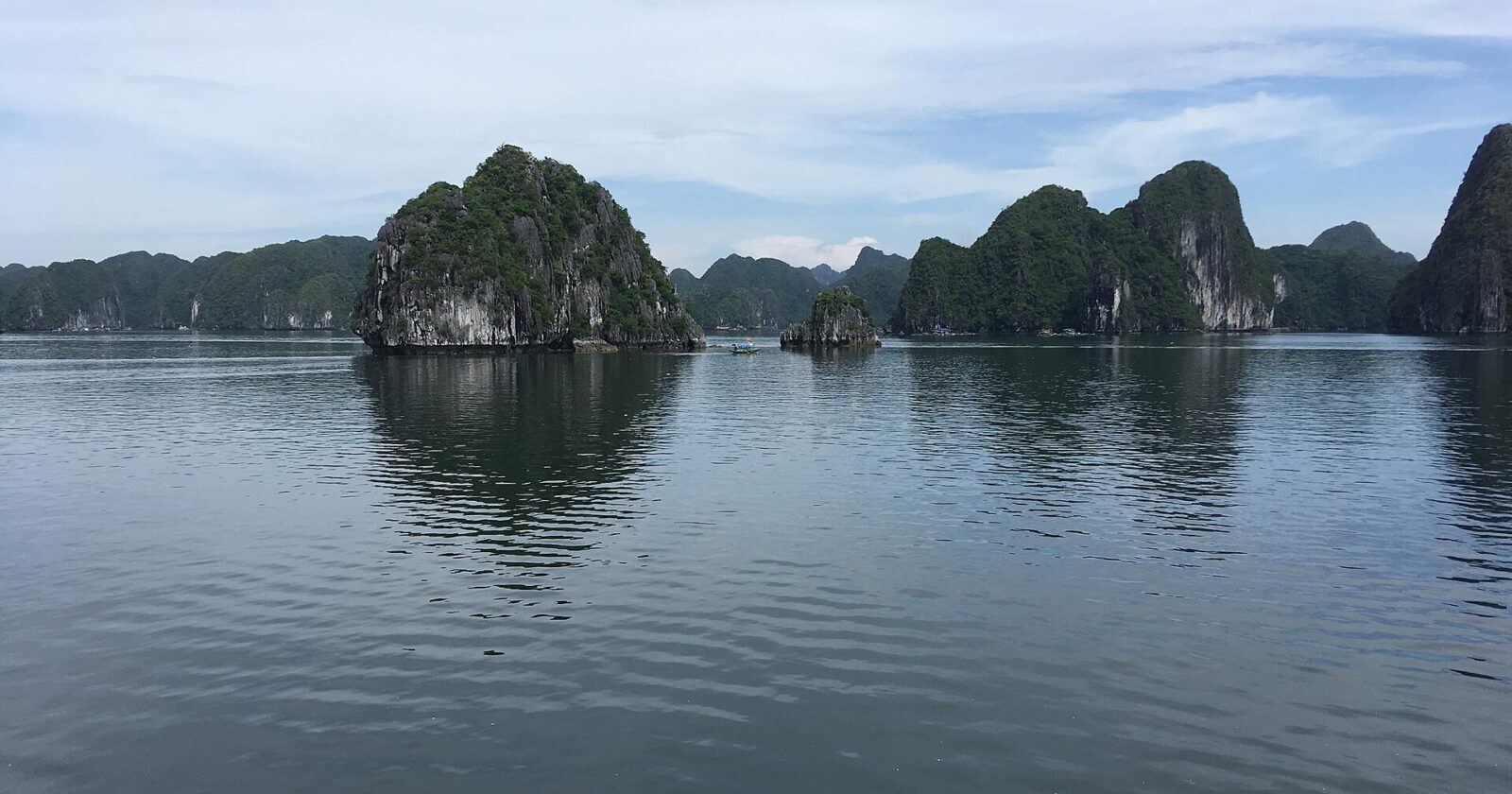
There’s no sign on the water where Ha Long Bay ends and Lan Ha begins. The provincial border between Quang Ninh and Hai Phong runs somewhere through the islands south of the main cruise routes, and a kayaker paddling across it wouldn’t notice. What you do notice is the traffic. On the Ha Long side, a mid-afternoon cave stop means a queue of tenders at the landing. On the Lan Ha side, it’s more often your boat, a lagoon and a few kayaks. Most people search the question as Lan Ha Bay vs Halong Bay, and the honest answer is that you’re choosing between two halves of the same seascape, run by two different provinces in two very different ways.
This page compares them on what matters when you book: crowds, price, boats, what you actually do there, the water, and how long it takes to get there from Hanoi. Then it matches each bay to the kind of traveller it suits. Prices were checked in October 2026; treat them as the right order of magnitude rather than a quote. For the wider picture, including the caves by name and the storm months, see our complete Ha Long Bay guide.
Lan Ha and Ha Long Side by Side
| Ha Long Bay | Lan Ha Bay | |
|---|---|---|
| Province | Quang Ninh | Hai Phong, off Cat Ba island |
| Size | About 1,553 km², 1,969 islands | More than 7,000 hectares, about 400 islands |
| UNESCO | Listed in 1994 | Added in 2023, when the site became “Ha Long Bay – Cat Ba Archipelago” |
| Boats | 508 tourist boats (2024 count), on fixed numbered routes | Day boats from Cat Ba up to ships such as the 39-cabin Paradise Grand |
| Where cruises board | Mostly Tuan Chau International Marina | Mostly Got pier on Cat Hai, or Ben Beo harbour on Cat Ba |
| From Hanoi | About 2.5 hours by expressway | Depends on the boarding pier; your operator gives the transfer time |
| Day cruise | US$40–60 standard; US$90–150 on the newer premium ships | Around US$25 from Cat Ba; more with a Hanoi transfer |
| Signature sights | Sung Sot Cave, Ti Top Island, Luon Cave, the Fighting Cock islets | Sea caves and lagoons by kayak, small beaches, Cai Beo floating village |
| Swimming | Only at Ti Top, on Route 2 | Easy, often straight off the boat |
| Best for | First-timers who want the big caves | Swimmers, kayakers and anyone who hates crowds |
The Short Answer
If you have one night and care more about the scenery than about ticking off Sung Sot, book Lan Ha. The karsts are just as dramatic, the boats are smaller, the water is usually cleaner, and you share the view with a fraction of the boats. It’s the better trip for most people, and it costs no more.
Stay with Ha Long if the famous caves are the point, if someone in your group would rather walk through a cave than paddle a kayak, or if you want the simplest, most direct transfer from Hanoi. And if you’re going between December and February, when nobody’s swimming, the gap narrows. Lan Ha is still quieter, but Ha Long’s big caves come into their own on a grey, cool day.
One Seascape, Two Provinces
Geologically, there’s no difference. Ha Long and Lan Ha are parts of the same drowned limestone landscape, and in 2023 UNESCO extended the Ha Long Bay World Heritage Site to take in the Cat Ba archipelago, which includes Lan Ha. The site is now officially “Ha Long Bay – Cat Ba Archipelago”.
What divides them is administration. Ha Long and Bai Tu Long belong to Quang Ninh province, which licenses every tourist boat and confines them to a set of numbered routes past the famous sights. Lan Ha belongs to Hai Phong, with its own permits, its own piers and a much smaller fleet. That’s why the two feel so different. In Ha Long, the routes funnel hundreds of boats towards the same half-dozen caves and beaches. In Lan Ha, there are simply fewer boats, spread across more small coves.
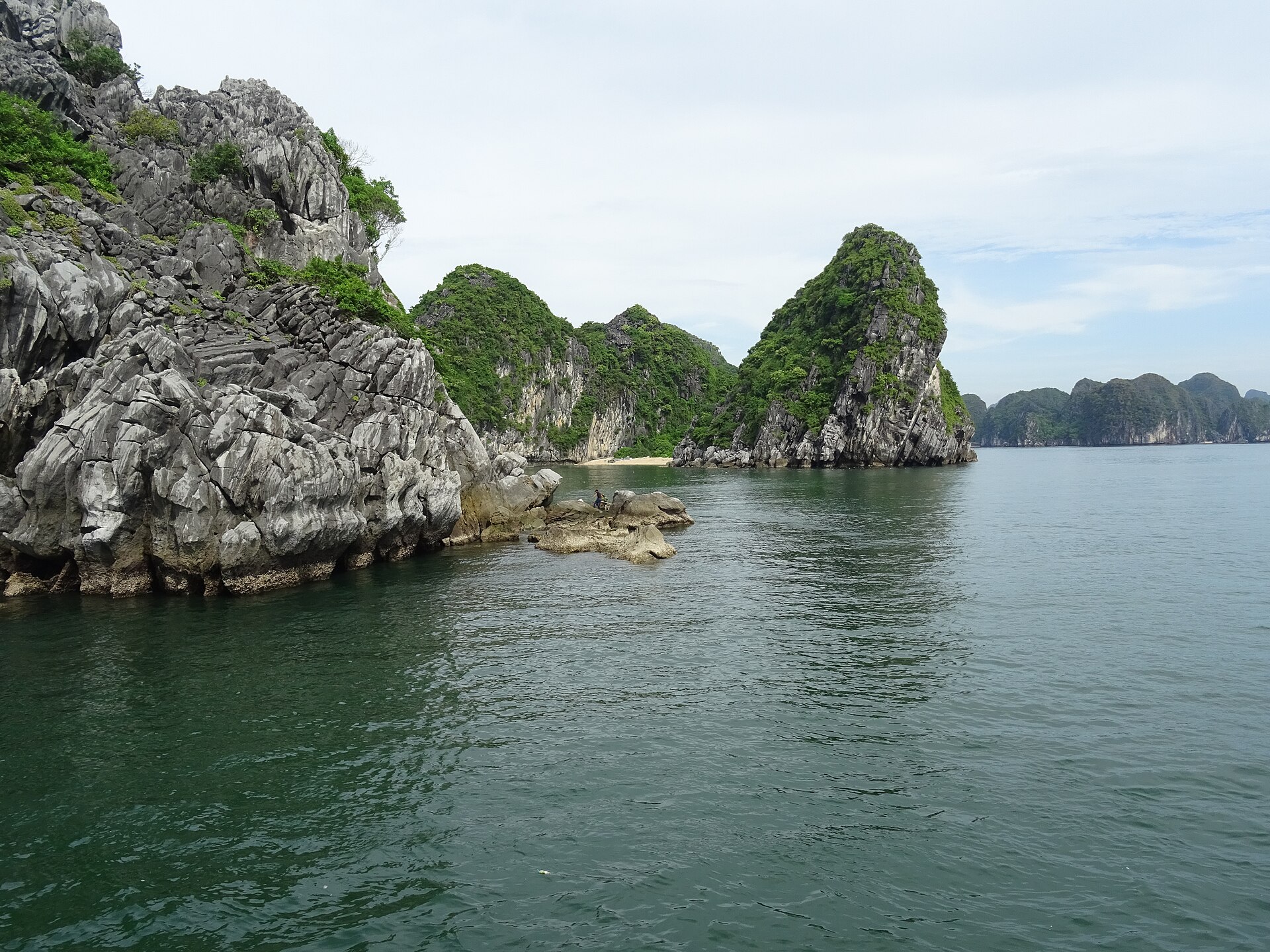
The difference in scale is worth keeping in mind. Ha Long Bay covers around 1,550 square kilometres. Lan Ha, at a little over 70, is far smaller but denser, with nearly 400 islands and more than a hundred small beaches packed into it. Operators often quote 139 beaches, many of them little more than a crescent of sand in a gap between two cliffs.
Crowds: The Biggest Difference
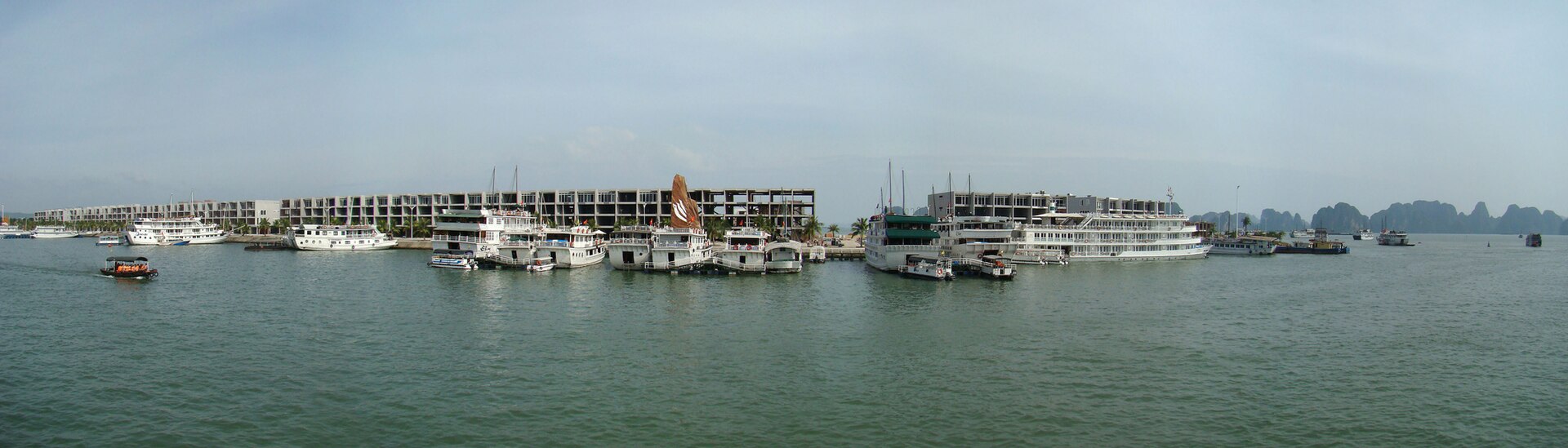
This is the reason most people end up choosing Lan Ha. When Quang Ninh announced its plan to modernise the fleet in late 2024, Ha Long Bay had 508 tourist boats, and Route 2 takes in Sung Sot Cave, Ti Top Island and Luon Cave. Boats on the route tend to arrive at the same places at roughly the same times, so at the busy hours Sung Sot is walked in a slow one-way file, the Ti Top staircase has traffic going both ways, and Luon’s lagoon fills with kayaks and bamboo boats.
Lan Ha is quieter, but let’s not oversell it. It has grown fast, the best-known lagoons and beaches can be busy around midday, especially at weekends and on public holidays, and day boats from Cat Ba town add to the traffic. What makes the difference is that there are far more places to go and far fewer boats trying to reach them. An overnight boat can usually find a cove to itself for the evening, and the kayaking happens in lagoons rather than queues.
Price: Closer Than It Looks
The headline comparison, a Lan Ha day boat at around US$25 against US$40–60 for a Ha Long day cruise, isn’t quite like for like. The Lan Ha price is for a boat leaving from Cat Ba, and it assumes you’re already on the island. The Ha Long price usually includes a round trip from Hanoi. Add the bus, ferry and a night’s accommodation on Cat Ba and the Lan Ha option costs about the same, but you get an island base and a much quieter day on the water for your money.
For overnight cruises, the tiers overlap. You’ll find budget, mid-range and premium boats in both bays at broadly similar prices: roughly US$65–120 per person for a budget two-day, one-night trip, US$120–200 for mid-range and US$200–350 for premium. So price shouldn’t decide it. What the money gets you is where they differ. In Lan Ha, a mid-range boat buys you longer kayaking, a beach and a quiet anchorage. In Ha Long it buys you the famous caves, with company.
One cost that trips people up: kayaking. On budget boats in Ha Long it’s sometimes charged on the day at US$10–15, while Lan Ha itineraries almost always include it, because it’s the main activity. Check the inclusions list either way. Our guide to choosing the best Ha Long Bay cruise explains what each tier really buys.
The Boats
Ha Long has large multi-deck ships, some with more than 40 cabins (Grand Pioneers Cruise II has 53), and a new generation of large day ships. They’re stable and well equipped, but mealtimes can feel busy and it takes several runs of the tender to get everyone ashore at each stop.
Lan Ha has small boats too, and they suit the narrow lagoons and small beaches. Large luxury ships sail here as well: Paradise Grand, a steel-hulled ship with 39 cabins, works only in Lan Ha Bay. If a quiet, small boat is part of why you’re choosing Lan Ha, check the cabin count before you book rather than assuming it.
What You Actually Do There
In Ha Long Bay
- Caves. Sung Sot, on Bo Hon island, is one of the bay’s major caves and the big stop on Route 2. Thien Cung and Dau Go are richly decorated and on Route 1.
- Ti Top Island. A path up to the summit for the classic panoramic view, and a beach at the bottom.
- Luon Cave. A low arch through a cliff into an enclosed lagoon, by kayak or bamboo boat. The loveliest short experience in the bay.
- The famous islets. The Fighting Cock and Incense Burner rocks, the second of which is on the back of the 200,000 dong note.
- Cua Van. The floating fishing village and its cultural centre, on Route 3.
In Lan Ha Bay
- Kayaking into lagoons. The main event. You paddle through low sea caves into enclosed lagoons at spots such as the Dark and Bright Cave, which you can also do by local rowing boat. How long you get on the water depends on the itinerary.
- Beaches. Small, often empty, and many reachable only from the water. Ba Trai Dao and Van Boi are regular swimming stops; Cat Dua, known as Monkey Island, is another.
- Swimming off the boat. On many Lan Ha boats you can climb down the stern ladder into clean water in the late afternoon.
- Cai Beo. A floating fishing village near Cat Ba town, where families still farm fish and mend nets.
- Cat Ba island. If you base yourself there, the national park, the village of Viet Hai and the island’s own beaches add a day or two on land.
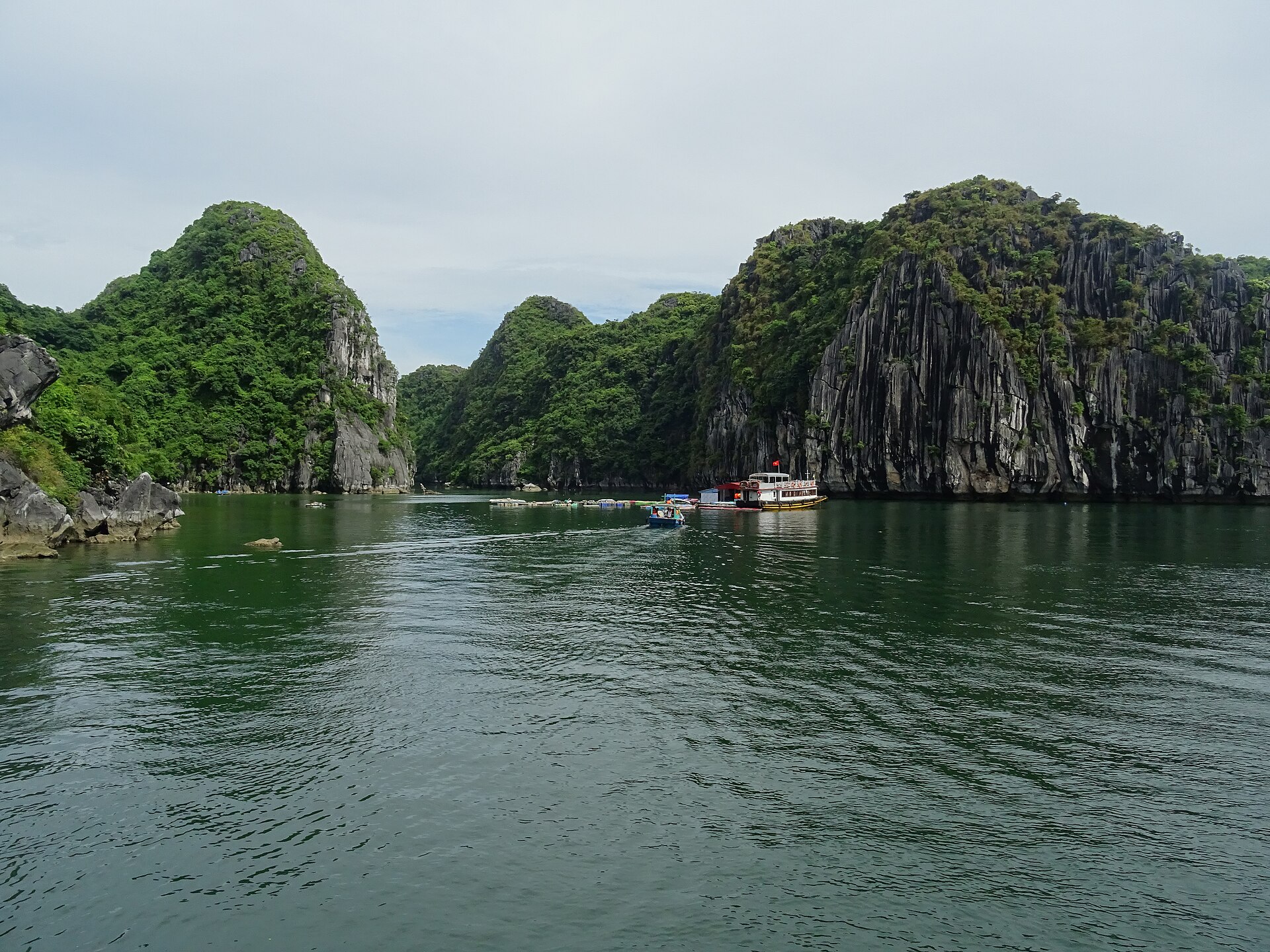
Put simply, Ha Long’s highlights are things you walk through and look at, and Lan Ha’s are things you paddle into and swim off. Which you’d rather do is most of the decision.
An afternoon in each, side by side
The difference is easiest to see on the clock. A Ha Long Route 2 boat runs to a set schedule, and when the tender leaves for Sung Sot depends on the itinerary you book. You queue at the landing, climb to the entrance and walk the cave with several other groups, then move on to Luon Cave, where kayaks and bamboo boats take turns through the arch. If there’s time, there’s a stop at Ti Top for the climb or a swim before the tender takes you back to the boat.
On a Lan Ha boat, the same hours usually start with the kayaks being lowered straight off the stern. You paddle for most of an hour through a low cave into a lagoon, where it’s often just your group and the sound of the water. After that comes a beach stop, a swim, and back on board to swim off the ladder while the boat moves to a quiet anchorage for sunset. Neither afternoon is bad. They’re simply different kinds of good, and it helps to know which you’re buying.
Where Lan Ha Falls Short
Lan Ha wins most comparisons, so it’s worth being clear about what it doesn’t do as well.
- No cave on the scale of Sung Sot. Lan Ha’s caves are mostly low sea caves you paddle through. If you want to walk through a vast chamber of stalactites, that’s Ha Long.
- The journey can be less simple. A cruise shuttle to Got pier is straightforward. Getting to Cat Ba independently by bus, ferry or cable car takes longer, and the ferries can be busy in summer.
- Cat Ba town isn’t the island idyll. It’s a busy harbour town of hotels, karaoke and seafood restaurants, crowded with Vietnamese holidaymakers in the June to August school holidays. The island’s beauty is out in the bay and in the national park, not on the seafront.
- Some lagoons are working water. Floating fish farms sit in several coves, and small beaches can collect flotsam after a storm. That’s part of a living bay, but it isn’t always the pristine scene the brochures promise.
- The gap is narrowing. As Lan Ha’s popularity grows, its best-known spots are getting busier. The difference is still large, but it’s smaller than it was a few years ago.
How the Seasons Change the Answer
From May to October, Lan Ha’s advantages are at their greatest: the water is warm, swimming and kayaking are the whole point, and the crowds in Ha Long are at their heaviest. This is also storm season. From roughly June to October, and above all in August and September, tropical storms push in from the sea and the authorities suspend sailings in both bays, sometimes for days. Weather affects them equally, so it shouldn’t decide which bay you choose, but it should make you book with an operator whose cancellation policy you’ve read.
From November to April the water cools, few people swim, and the karsts often sit in mist. March to May is the most settled period of the year on the water, and October and November bring clearer skies as the storms fade. In the cooler months the choice comes down to crowds against caves: Lan Ha remains quieter, while Ha Long’s great caves are a better use of a grey afternoon than a chilly kayak. Weekends and Vietnamese public holidays fill boats in both bays whatever the season.
Water and Swimming
Lan Ha’s water is usually cleaner and clearer, and swimming is part of almost every itinerary from May to October. In Ha Long Bay proper, the swimming stop is Ti Top beach on Route 2; Soi Sim beach has been closed to visitors since 2020. If swimming matters to you, this alone settles it.
From November to April the water is cool and few people swim in either bay, although you’ll see a hardy few in Lan Ha in the warmer spells of spring. Whatever the month, swim only where the crew says it’s allowed, and never during a storm warning.
Getting There from Hanoi
Ha Long is the more direct trip. Cruise shuttles leave the Old Quarter at around 07:30–08:30 and reach Tuan Chau International Marina in about 2.5 hours. Our guide to getting from Hanoi to Ha Long Bay compares shuttles, buses and private cars.
Most Lan Ha cruises board at Got pier on Cat Hai island, which the shuttle reaches via the Hanoi–Hai Phong expressway and the long Tan Vu–Lach Huyen sea bridge; your operator will give you the transfer time. Boats based on Cat Ba leave from Ben Beo harbour. If you want to stay on the island and take a day boat from there, our page on getting from Hanoi to Cat Ba Island covers the bus, ferry and cable-car combinations. It takes longer than a cruise shuttle, but it gives you the cheapest good day on the water in the region.
Which Bay Suits Which Traveller
| If you… | Choose | Why |
|---|---|---|
| Want to see Sung Sot and the Ti Top view | Ha Long | They’re only on Ha Long’s routes |
| Love kayaking and swimming | Lan Ha | Longer paddles, more beaches, cleaner water |
| Hate crowds | Lan Ha | Fewer boats and more places to go |
| Are travelling with young children | Either | Lan Ha for beaches; Ha Long for caves and bigger boats |
| Have limited mobility | Ha Long, on a big boat | Larger ships, bamboo-boat options; though cave steps remain |
| Are backpacking on a budget | Lan Ha, from Cat Ba | A day boat for about US$25 and a cheap island base |
| Are visiting in December to February | Either, leaning Ha Long | No swimming anywhere; the big caves shine on grey days |
| Have only one day | Ha Long | The shortest, simplest transfer from Hanoi |
Can You Do Both?
Yes, with a little planning. The easiest way is to take a Ha Long cruise and then carry on to Cat Ba rather than returning to Hanoi: our Cat Ba transport guide covers the speedboat from Tuan Chau to Gia Luan on the island. Spend a night or two on Cat Ba, take a Lan Ha day boat, and head back to Hanoi via Hai Phong. You get Sung Sot and the Ti Top view on day one and the lagoons on day two or three, without paying for two cruises.
Some two-night cruises also cover more ground than one-night trips, so read the day-by-day plan to see which waters you’ll actually be in. The third bay, Bai Tu Long, north-east of Ha Long, is the quietest of all and worth considering if you’ve been to Ha Long before. Our Ha Long Bay guide puts all three side by side.
Lan Ha Bay vs Ha Long Bay FAQ
Is Lan Ha Bay part of Ha Long Bay?
Geologically, yes. It’s the southern part of the same limestone seascape, and since 2023 it has been part of the same UNESCO World Heritage Site, “Ha Long Bay – Cat Ba Archipelago”. Administratively it’s separate: Lan Ha belongs to Hai Phong, Ha Long to Quang Ninh, with different boats, permits and piers.
Is Lan Ha Bay less crowded than Ha Long Bay?
Yes, noticeably, though it isn’t empty. The most popular lagoons and beaches can be busy around midday, especially at weekends. But with far fewer boats and many more coves, overnight cruises in Lan Ha usually anchor somewhere quiet, and kayaking rarely involves a queue.
Which is cheaper, Lan Ha or Ha Long?
Overnight cruises cost much the same tier for tier. On a budget, look at a Lan Ha day boat from Cat Ba: Halong Tour and Transport Service lists one at US$25 per person for groups of 16–25, with smaller groups paying more, but only once you’ve paid to get to the island. Kayaking is more often included in Lan Ha prices.
Is the scenery different?
Only subtly. Lan Ha’s islands tend to be smaller and greener, with more beaches, and Ha Long has the grander open views and the big caves. Most people couldn’t tell the two apart from a photo. The difference is in how many other boats are in the frame.
Which is better for kayaking?
Lan Ha. You paddle through sea caves into enclosed lagoons, and your itinerary will say how long the session runs. Ha Long’s kayaking is mostly concentrated at Luon Cave, which is lovely but busy in the afternoon.
Can you swim in Ha Long Bay?
Yes, at Ti Top beach on Route 2; nearby Soi Sim is closed to visitors. In Lan Ha, swimming is easier and the water is usually cleaner, often straight off the boat.
Which is better for a first visit?
For most first-timers, Lan Ha, because the experience of being among the islands is better when you’re not sharing it with hundreds of boats. Choose Ha Long if Sung Sot Cave and the Ti Top view are high on your list.
Planning the Rest of Your Ha Long Trip
Once you’ve picked a bay, the next decisions are the boat and the length of the trip. Our guide to choosing the best Ha Long Bay cruise covers the price tiers and the questions to send an operator, and our hour-by-hour 2 day, 1 night itinerary shows how the standard trip actually runs.
There’s a third option, too. North-east of Ha Long, Bai Tu Long Bay is the quietest of the three, with a working floating village at Vung Vieng and overnight anchorages where you may not see another cruise ship. It’s the one to consider if you’ve seen Ha Long before.
If Lan Ha appeals but you’d rather sleep on land and choose your own days, our Cat Ba Island guide covers basing yourself on the island, from Lan Ha day boats to the national park and where to stay.
Related Hanoi Guides
- Ha Long Bay: The Complete Visitor Guide
- Best Ha Long Bay Cruises: How to Choose
- Ha Long Bay 2 Days, 1 Night, Hour by Hour
- Hanoi to Cat Ba Island
- How to Get from Hanoi to Ha Long Bay
- Adventure Activities Around Hanoi
- Day Trips from Hanoi
Photo Credits
Featured image, islands and calm water in Lan Ha Bay: Lan Ha Bay 11 by Christophe95, CC BY-SA 4.0, via Wikimedia Commons.
A small beach between the islands: Lan Ha Bay 03 by Christophe95, CC BY-SA 4.0, via Wikimedia Commons.
Cruise boats moored at the harbour in Ha Long: HalongHarbour tango7174 by Tango7174, CC BY-SA 4.0, via Wikimedia Commons.
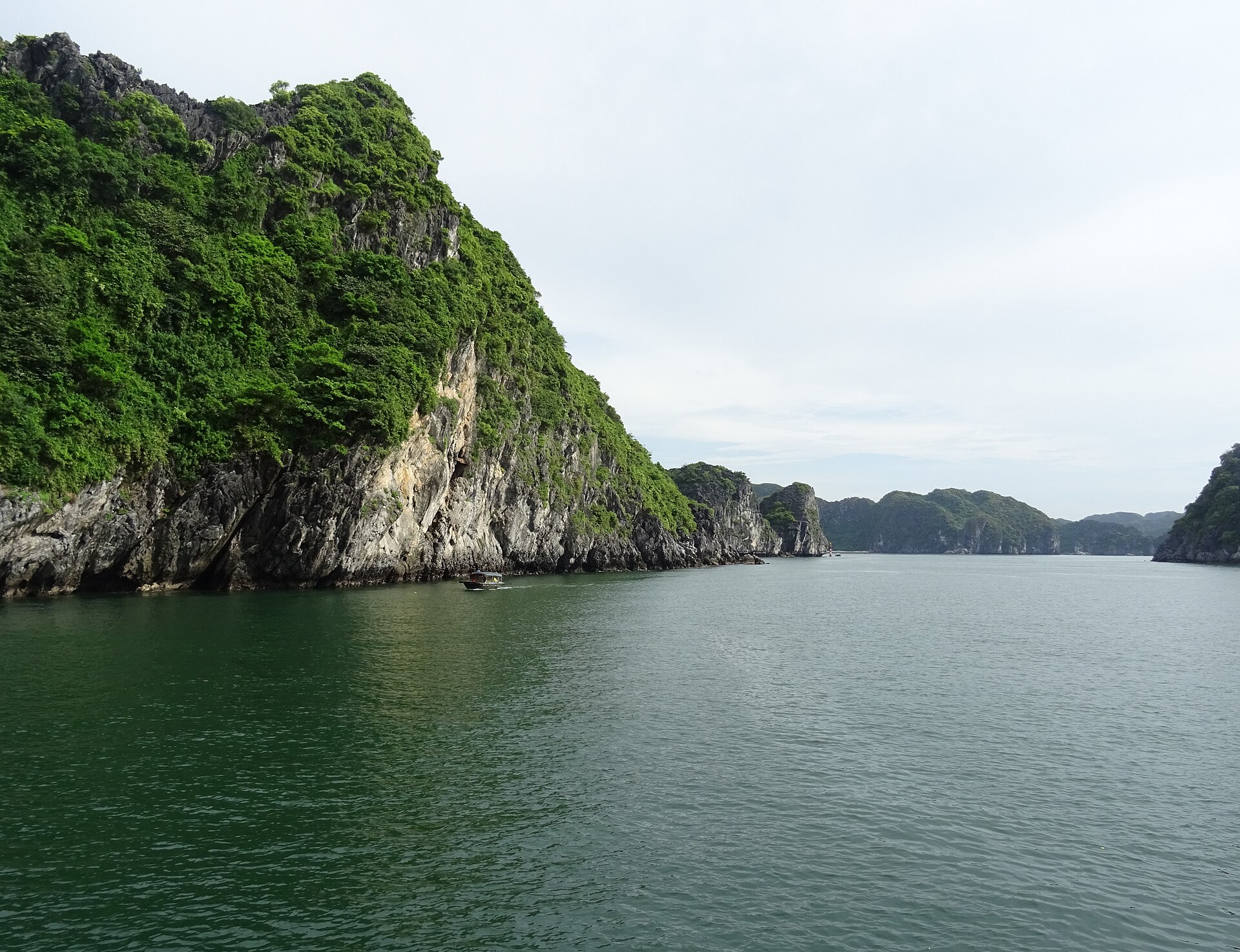
A lone boat below a cliff: Lan Ha Bay 01 by Christophe95, CC BY-SA 4.0, via Wikimedia Commons.
A lagoon entrance and fish farm: Lan Ha Bay 05 by Christophe95, CC BY-SA 4.0, via Wikimedia Commons.