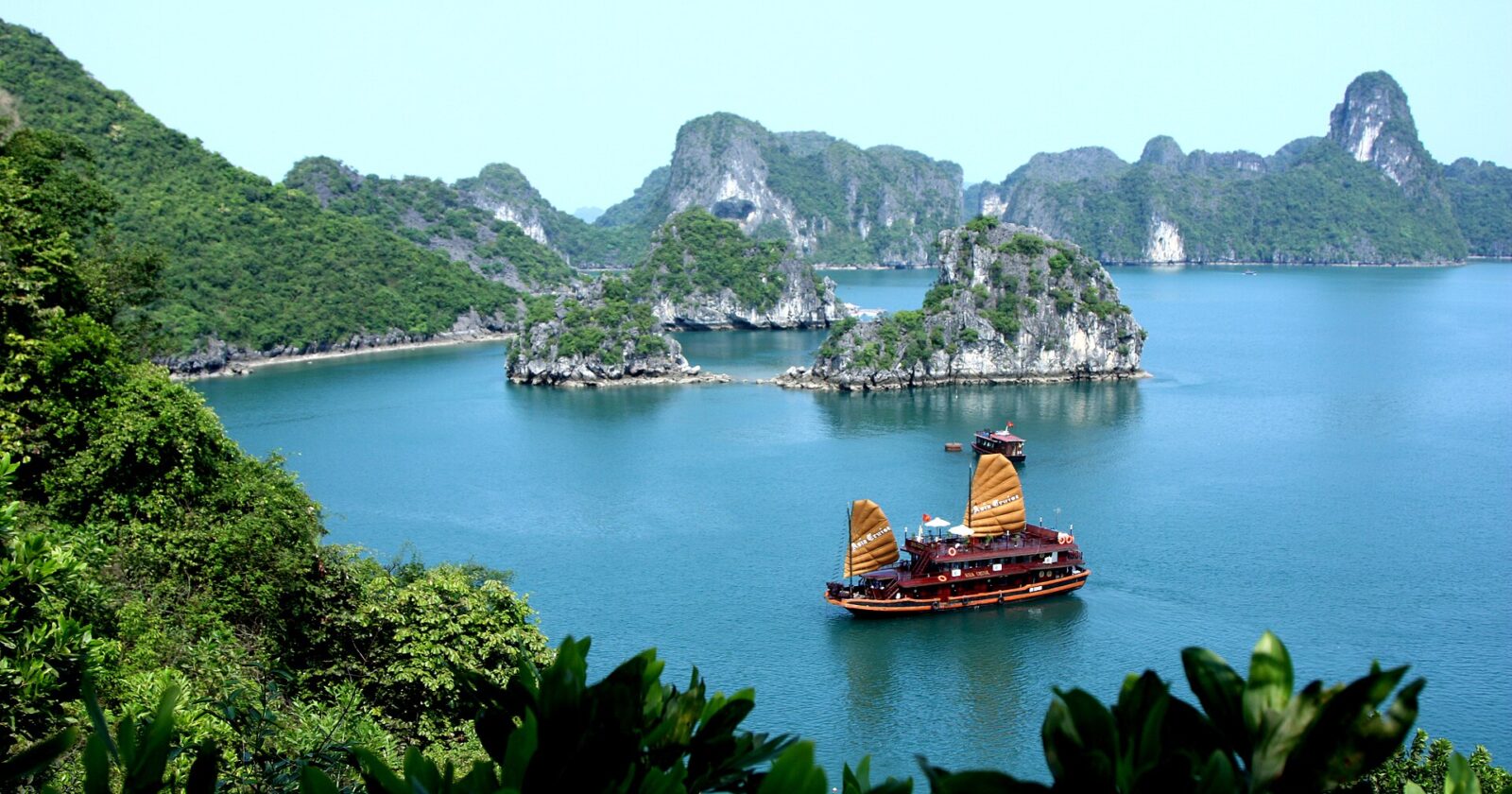
Most two-day cruise itineraries read like a packed day out: shuttle, lunch, cave, kayak, sunset party, cooking class, dinner, squid fishing, tai chi, breakfast, another cave, brunch, shuttle. Put the times next to them and the picture changes. About five of your 31 hours are spent in a van and eight asleep, and the two best parts of the trip, the evening light and the silent first hour after dawn, aren’t on the list at all. This page is the Halong Bay 2 day 1 night trip, as nearly every booking site spells it, laid out hour by hour, so you know what you’re buying before you pay for it.
It follows a typical mid-range boat on Ha Long’s Route 2, the most common itinerary, from the Old Quarter pickup to the drop-off the next afternoon. Then it covers how the Lan Ha and Bai Tu Long versions differ, what’s included and what isn’t, what it costs, what to pack, and whether one night is really enough. Timings vary by a half-hour either way between operators, and prices were checked in October 2026; treat them as the right order of magnitude rather than a quote. For the bigger picture, including which bay to choose and when to go, see our complete Ha Long Bay guide.
Two Days, One Night at a Glance
| Typical (2026) | |
|---|---|
| Hotel pickup in Hanoi | 07:30–08:30, Old Quarter and around Hoan Kiem Lake |
| Road time | Roughly 2.5 to 3 hours each way by expressway; ask your transfer operator about rest stops |
| Boarding | Around 11:30–12:30 |
| Time on board | About 22 hours |
| Disembarking | 10:30–11:00 on day two |
| Back in Hanoi | Roughly 14:30–16:00 |
| Price per person, sharing | US$65–120 budget · US$120–200 mid-range · US$200–350 premium · US$350–600 luxury |
| Usually included | Meals on board, route and overnight fees, kayak or bamboo boat (mid-range and up), shuttle |
| Usually extra | Drinks, tips, spa; on budget boats sometimes the kayak and the shuttle |
Day One, Hour by Hour
07:30–08:30 · Pickup in the Old Quarter
The shuttle comes to your hotel, usually a nine-seat “limousine” van with reclining seats on mid-range trips and above, or a larger coach on budget ones. You’ll be given a pickup window rather than a time. Be in the lobby at the start of it, because the driver has a round of hotels to collect and won’t wait long. If you’re first on the list, expect 30 minutes or so of circling the Old Quarter while the others are picked up.
Most shuttles only collect from the Old Quarter and the streets around Hoan Kiem Lake, which is one good reason to stay there the night before. Our guide to where to stay in Hanoi explains the neighbourhoods. Leave your main suitcase at the hotel. Nearly every Hanoi hotel will store it for free, and you’ll be glad not to haul it on and off a tender.
Around 10:00 · The rest stop
Partway along the expressway, the van may pull into a roadside rest centre; confirm with your transfer operator whether and for how long. There are toilets, coffee and snacks, and usually a very large souvenir hall of lacquerware, embroidery, stone carving and pearls. Nobody minds if you don’t buy anything, and prices here are no better than in Hanoi. Use the toilet, get a coffee, stretch your legs.
11:30–12:30 · The marina
Most Ha Long boats leave from Tuan Chau International Marina. At this time of day it’s the least romantic place in the bay: vans backing into the drop-off lane, porters wheeling luggage down the pontoons, dozens of boats loading at once. The crew check your passport and booking confirmation, then take you to the boat, either straight up a gangway or by tender. You’ll get a welcome drink and a safety briefing. Listen to the part about life jackets.
12:30–14:00 · Lunch as the boat sails out
You’ll usually get the cabin keys and a few minutes to settle in, then lunch is served as the boat leaves: several courses, heavy on seafood, with vegetarian dishes if you asked when you booked. Tuan Chau is a major departure point for Ha Long and Lan Ha cruises, so you’ll leave with other boats doing the same thing. Soon the islands start to close in on both sides and the engine note drops. Take your coffee up to the sun deck. This is when it starts to feel like the photos.
14:30–17:00 · The afternoon stop
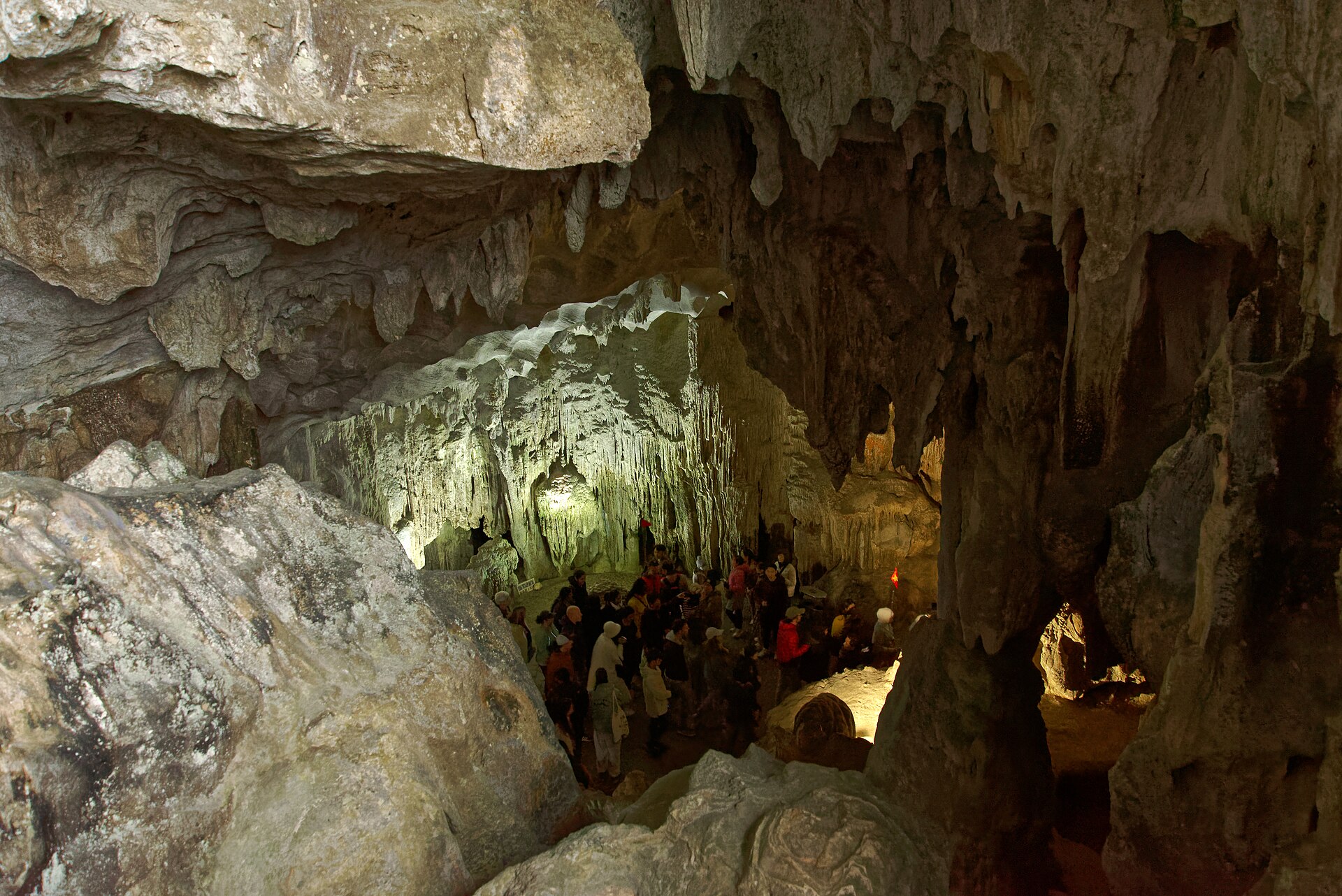
This is the main excursion, and it depends on your route. On Route 2 the stops come from Sung Sot Cave, Luon Cave by kayak or bamboo boat, and Ti Top Island for the viewpoint and the beach; your itinerary says which you get. Route 1 boats do Thien Cung and Dau Go caves instead. In Lan Ha, the afternoon is kayaking and a beach.
Here’s the honest part. Mid-afternoon is when every boat on the route arrives at the same few places. Sung Sot is a popular stop, so allow for the climb to the entrance and expect to move through in a slow file with other groups; ask the crew how long your visit lasts. It’s still an extraordinary cave. Luon is lovelier, and quieter on the water. If your boat offers the cave in the morning instead, take it.
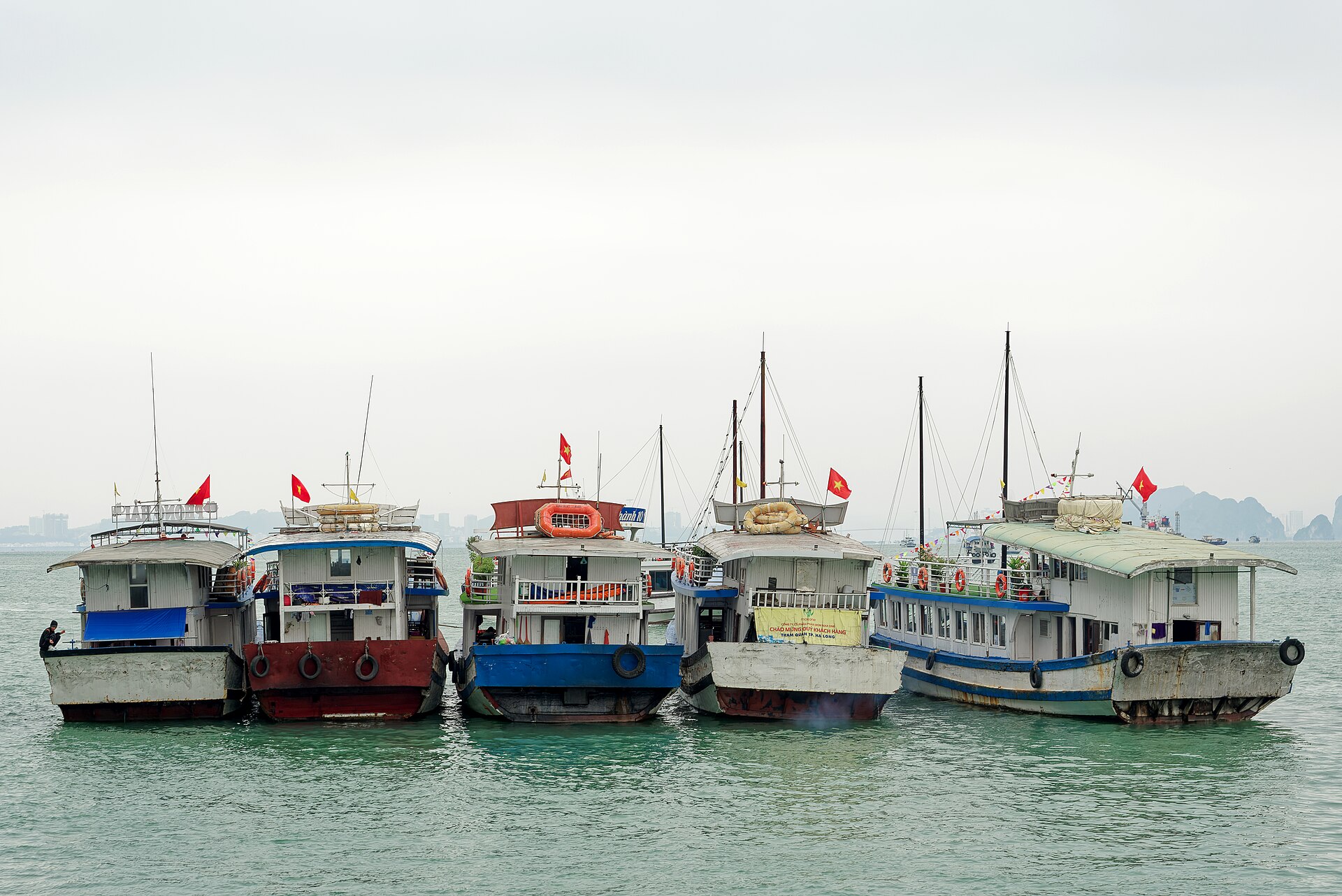
At Ti Top, a path climbs to the viewpoint above the beach where you can swim, so allow time for the climb. If you have energy for only one, do the climb. Take water, and wear shoes with grip, not flip-flops.
17:00–18:30 · Sunset on the top deck
Back on board, the boat moves to its overnight anchorage while the day boats head home, and the bay quietens. Most boats run a “happy hour” on the sun deck, often with discounted or two-for-one drinks. Sunset comes at about 17:15 in December and about 18:40 in June, so in winter this hour starts earlier than the itinerary suggests. Whatever the season, this is the best hour of the trip. Be on deck for it, even if you don’t drink.
18:30 · The “cooking class”
Twenty minutes with the chef, rolling nem (fried spring rolls) that then appear at dinner. It isn’t a class in any serious sense, and nobody pretends otherwise. Children love it. If you’d rather stay on deck for the last of the light, nobody will mind.
19:00–20:30 · Dinner
A set menu of several courses, often by candlelight, heavy on prawns, squid, fish and clams, with rice and vegetables. On better boats it’s genuinely good. On budget boats it’s plentiful and forgettable. Drinks are extra and priced like a hotel bar: beer about US$3–5, cocktails US$6–10. Most boats don’t allow you to bring your own, or charge corkage if you do.
20:30 onwards · Squid fishing, a film or an early night
The crew set out bamboo rods and a lamp at the stern for squid fishing. Very few people catch anything, and hardly anyone minds. Some boats run karaoke or show a film in the lounge; a few have a spa. On a clear night, especially from October to December, turn off the deck lights near you and look up. Most people are in bed by ten, which is sensible given what the morning offers.
A note on sleep. Many boats run a generator through the night to power the air-conditioning, and cabins near the stern or on the lowest deck hear it most. Earplugs cost nothing and help. The bay is sheltered by thousands of islands, so there’s almost never any motion to speak of.
Day Two, Hour by Hour
05:00–06:30 · Dawn, if you set an alarm
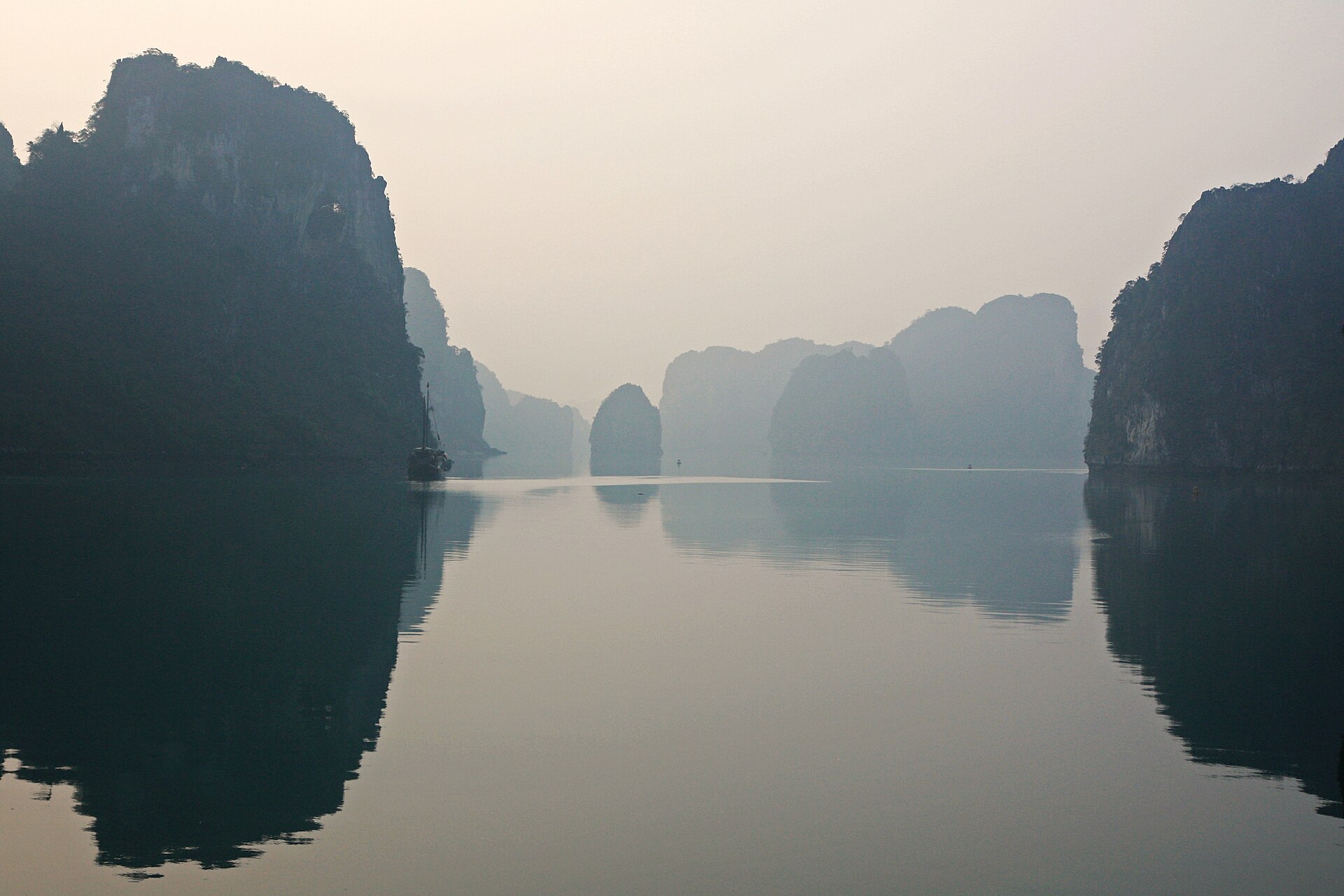
This is the part of the trip you can’t get any other way. The day boats haven’t left the marina yet, the water is usually flat calm, and mist often hangs between the islands. Sunrise is just after 05:00 in June and about 06:30 in December. Tai chi on the sun deck is part of the morning programme on many boats, and start times vary: Dragon Legend schedules it for 06:00, Paradise Grand for 06:30–07:00. In summer the sun is up well before that, so if the dawn is what you came for, set your own alarm.
06:30–07:00 · Light breakfast
Tea, coffee, pastries and fruit, enough to keep you going until brunch.
07:00–08:30 · The morning activity
Depending on the route, this is a cave you didn’t do yesterday, a short kayak or bamboo-boat loop, or a visit to a pearl farm, where you’ll see how oysters are seeded before being shown into a showroom. Morning cave visits are noticeably calmer than afternoon ones, because most of the day boats haven’t arrived yet. The pearl farm is the least interesting half hour on many itineraries. Nobody will mind if you don’t buy, and Hanoi’s jewellers sell the same pearls without the boat mark-up.
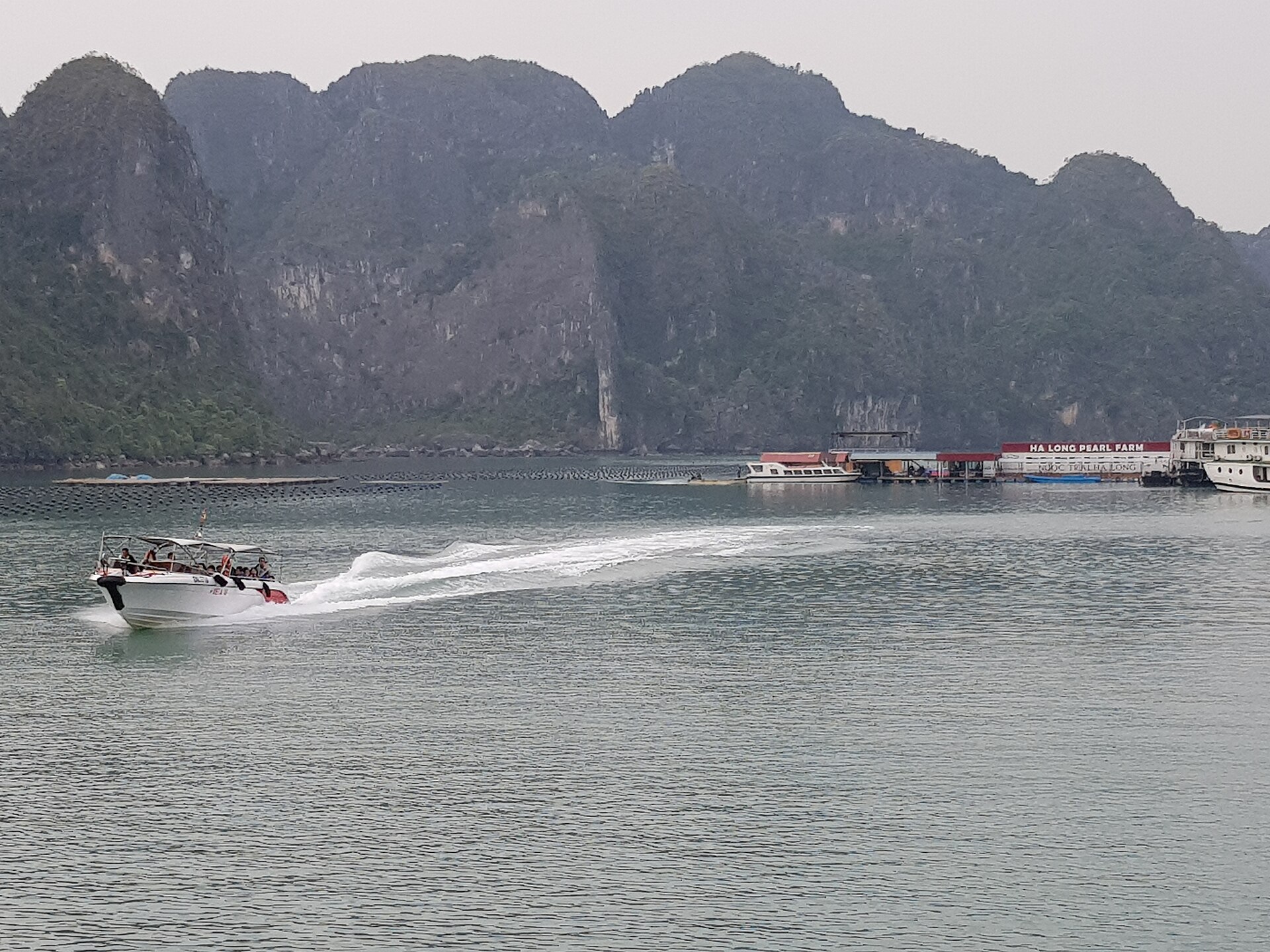
09:30–10:00 · Leaving your cabin
This catches people out. You’ll be asked to leave your cabin in the morning, with luggage outside the door, even though you’ll be on board for a while longer: checkout is 09:45–10:00 on Dragon Legend and 09:30–10:00 on Paradise Grand. Pack the night before and keep a small bag with you for the rest of the morning. Settle the bar bill now, too, and put the crew tip in the envelope if you’re leaving one. US$5–10 per guest is normal. Our guide to tipping in Vietnam has more on what’s expected.
09:00–10:30 · Brunch on the way back
The boat turns for the marina while brunch is served, usually a mix of Vietnamese and Western dishes. It’s the last real look at the islands, and it goes by quickly. Eat on deck if the boat lets you.
10:30–11:00 · Disembarking
Back at Tuan Chau, the marina is as busy as it was yesterday, because the next wave of guests is arriving. You’ll wait a little for the van, then set off.
11:30–16:00 · Back to Hanoi
Some shuttles stop for lunch on the way; many don’t, since you’ve just had brunch. Arrival in Hanoi depends on the operator, traffic and the drop-off order (Dragon Legend schedules 16:00–16:30), so ask for your boat’s return schedule when you book. If you’re flying out the same day, leave a generous margin and tell the operator, because some shuttles can drop off at Noi Bai Airport. We wouldn’t book a flight before the evening. Some operators can also arrange a transfer onwards to Ninh Binh instead of Hanoi, for an extra fee; ask when you book if you’re heading south next.
Where the 31 Hours Actually Go
Door to door, from an 08:00 pickup to a 15:00 drop-off, a 2D1N trip lasts about 31 hours. Roughly, they’re spent like this:
| What | Hours | Notes |
|---|---|---|
| In the van | About 5 | Plus a half-hour rest stop on the way out |
| At the marina and on tenders | About 1.5 | Boarding, disembarking and getting to each stop |
| Meals | About 4.5 | Lunch, dinner, breakfast and brunch |
| Organised activities | About 5 | Caves, kayaking, cooking class, squid fishing, tai chi |
| Free time on deck | About 3 | Mostly sunset and the early morning |
| In your cabin, awake | About 2 | Showers, packing, a rest |
| Asleep | About 8 | If the generator lets you |
Put that way, the free time on deck, three hours or so, is what you’re really paying for, along with the chance to be in the bay at dusk and dawn. That’s worth knowing when you compare boats. A shorter schedule that boards later and lands earlier doesn’t just cut hours. It cuts the best ones.
How the Lan Ha and Bai Tu Long Versions Differ
The shape is the same on all three bays: van, boat, afternoon activity, sunset, dinner, dawn, brunch, van. What changes is what fills it.
Lan Ha Bay
Lan Ha trips usually travel via Hai Phong, with a boat or ferry transfer to where the cruise starts, so the journey can take a little longer. The afternoon is typically kayaking through lagoons and time on a small beach, and many boats let you swim straight off the stern. There are fewer caves and noticeably fewer boats. For swimmers and kayakers it’s the better one-night trip. Our page on getting from Hanoi to Cat Ba Island covers the transport if you’d rather base yourself on the island.
Bai Tu Long Bay
Bai Tu Long trips leave from the north-eastern side of Ha Long and head away from the main traffic. The afternoon usually includes a rowing-boat visit to the floating fishing village at Vung Vieng, and the overnight anchorage is quieter than anywhere on the Ha Long routes. It suits people who care more about peace and scenery than about Sung Sot.
Ha Long Route 1 and Route 3
Route 1 swaps Sung Sot and Ti Top for Thien Cung and Dau Go caves and a slow pass of the Fighting Cock and Incense Burner islets. There’s no swimming. Route 3 includes the Cua Van cultural centre and the Ba Ham lakes. Whatever the route, the route fee (250,000 VND per person on Routes 1 and 2, 200,000 VND on Route 3) and the overnight fee are almost always included in the price.
What’s Included, and What Isn’t
| Usually included | Sometimes included | Almost never included |
|---|---|---|
| Meals on board: lunch, dinner and breakfast, with a second lunch on some boats (check your package) | Return shuttle from Hanoi (US$8–12 each way if not) | Drinks beyond water, tea and coffee |
| Route sightseeing and overnight fees | Kayaking on budget boats (US$10–15 if charged) | Crew tips (US$5–10 per guest) |
| Cave entry on the route | Airport drop-off | Spa treatments (US$15–40) |
| Kayak or bamboo boat, mid-range and up | Onward transfer to Ninh Binh | Travel insurance |
| Activities such as a cooking class, squid fishing and tai chi (they vary by boat) | Single supplement (ask your operator) |
What It Costs
Per person, sharing a twin or double cabin, for two days and one night:
- Budget: US$65–120 (about 1.7–3.1 million VND). Older boats, small cabins, coach transfers, and extras that add up.
- Mid-range: US$120–200 (about 3.1–5.2 million VND). Newer boats, kayaks and fees included, limousine vans. The best value.
- Premium: US$200–350 (about 5.2–9.1 million VND). Balcony cabins, better food, smaller groups.
- Luxury: US$350–600 (about 9.1–15.6 million VND). Suites and polished service. Rarely worth it for one night.
A realistic all-in figure for a mid-range trip, with a couple of drinks and a tip, is about US$150–230 per person. Our guide to choosing the best Ha Long Bay cruise explains what each tier really buys, and where the extra money stops paying back.
Is One Night Enough?
For most people, yes. One night gets you the two things a day trip can’t: the evening and the dawn. Beyond that, the extra value of a second night depends on why you came.
- One night is right if the bay is one stop on a longer northern Vietnam trip, you’re travelling on a fixed budget, or you mainly want to see it rather than spend time in it.
- Two nights is worth it if the bay is the highlight of your trip, you want Lan Ha or Bai Tu Long properly, or you want real time in a kayak or on a beach. Ask whether you stay on the same boat both nights: on some itineraries you spend day two on a smaller day boat while the main boat goes back to swap guests.
- A day trip only makes sense if you truly have just one spare day. You’ll spend more time on the road than on the water, in the flattest light of the day.
If you’re fitting the cruise into a bigger trip, our seven-day Hanoi and northern Vietnam itinerary and the ten-day Vietnam route from Hanoi both show where one night fits best.
What to Pack for One Night
- A small bag, not your suitcase. Cabins are compact and tenders are wobbly. Leave the rest at your Hanoi hotel.
- Your passport. The crew check it, along with your booking confirmation, when you board.
- Shoes with grip. Cave staircases get slippery in humid months, and Ti Top’s steps are steep.
- Swimwear and a quick-dry towel, from May to October, and all year in Lan Ha if you’re hardy.
- A warm layer. For the deck at night from November to March, and for air-conditioned cabins all year.
- A dry bag for your phone on the kayak.
- Cash in dong for drinks and tips. Some boats add a surcharge for cards. Our money guide covers ATMs and exchange.
- Earplugs, insect repellent and sunscreen.
Our full Hanoi packing list covers the rest of the trip.
Five Small Things That Make the Night Better
- Ask for the morning cave slot if the boat offers a choice. It’s the same cave with a fraction of the people.
- Ask for a cabin away from the generator and the bar when you book, not when you board.
- Pack the night before so the morning is for the deck, not for your suitcase.
- Tell the operator about dietary needs in advance. Vegetarian and vegan menus are routine on mid-range boats if they know ahead. Our vegetarian guide to Hanoi helps with the rest of the trip.
- Don’t book the night train or a flight too tightly on day two. Traffic back into Hanoi on a Sunday afternoon can add an hour.
Ha Long Bay 2 Days, 1 Night FAQ
Is the Halong Bay 2 day 1 night trip worth it compared with a day trip?
Yes, for almost everyone who can spare the night. The day trip gives you the middle of the day, when the light is flattest and every boat is out. The overnight gives you sunset, a quiet evening at anchor and the dawn, which are the parts people remember. The price difference is often smaller than it looks, because the day trip is still a long, tiring day.
What time will I get back to Hanoi?
It depends on the operator, traffic and where your hotel falls in the drop-off order. Dragon Legend schedules arrival in Hanoi at 16:00–16:30, so ask for your boat’s return schedule when you book.
Can I bring my big suitcase?
You can, but you shouldn’t. Cabins have little storage, and getting a large case on and off a tender is awkward. Nearly every Hanoi hotel will store your luggage free while you’re away.
Can I leave the cruise and go somewhere other than Hanoi?
Often, yes. Many operators can arrange a transfer to Noi Bai Airport or onwards to Ninh Binh, usually for a fee. Arrange it when you book rather than on the boat.
Are meals and drinks included?
Meals on board are included, but the count and labels vary by package: Indochina Junk lists two lunches, dinner and breakfast, while Paradise Grand lists lunch, dinner, a light breakfast and breakfast. Check your booking for which drinks are complimentary. Alcohol, soft drinks and juices are usually extra.
What happens if it rains?
The trip goes ahead. Light rain and mist don’t stop boats, and the bay can look magnificent in them. Only an official storm warning stops sailings, most often between June and October, and then reputable operators rebook or refund you.
Is a one-night cruise suitable for children?
Yes. Children tend to love the kayaking, the cooking class and the squid fishing. Ask for family or connecting cabins and child-sized life jackets, and give small children a hand on cave staircases and tenders. Our family itinerary for Hanoi shows how to pace the trip.
Planning the Rest of Your Ha Long Trip
Once you know how the trip runs, the next decisions are which boat and which bay. Our guide to choosing the best Ha Long Bay cruise covers the price tiers and the questions to send an operator, and the complete Ha Long Bay guide compares the three bays and the months when storms cancel sailings.
If you’re still torn between the bays, our Lan Ha Bay vs Ha Long Bay guide compares an afternoon in each, side by side, along with prices, boat sizes and the seasons when the choice matters most.
For a full breakdown of fees, extras and realistic all-in totals, see our guide to what a Ha Long Bay cruise really costs.
Related Hanoi Guides
- Ha Long Bay: The Complete Visitor Guide
- Best Ha Long Bay Cruises: How to Choose
- How to Get from Hanoi to Ha Long Bay
- Hanoi to Cat Ba Island
- Hanoi and Ha Long Bay Itinerary
- Seven Days in Hanoi and Northern Vietnam
- Where to Stay in Hanoi
- What to Pack for Hanoi
Photo Credits
Featured image, a junk among the islands of Ha Long Bay: Asia Cruise Junk in Halong bay by Arianos, Public domain, via Wikimedia Commons.
Mist at dawn between the islands: Sunrise, Halong Bay (5678869517) by Andrea Schaffer from Sydney, Australia, CC BY 2.0, via Wikimedia Commons.
The main chamber of Sung Sot Cave: Sung Sot Cave, Ha Long Bay, Vietnam, 20240128 1549 3836 by Jakub Hałun, CC BY 4.0, via Wikimedia Commons.
Day boats moored off Ti Top Island: Boats on the coast of Titov Island in Ha Long Bay, Vietnam, 20240128 1331 3730 by Jakub Hałun, CC BY 4.0, via Wikimedia Commons.
A pearl farm platform in the bay: Halong Bay Titov island (41569) by Andre Hospers, CC BY 4.0, via Wikimedia Commons.