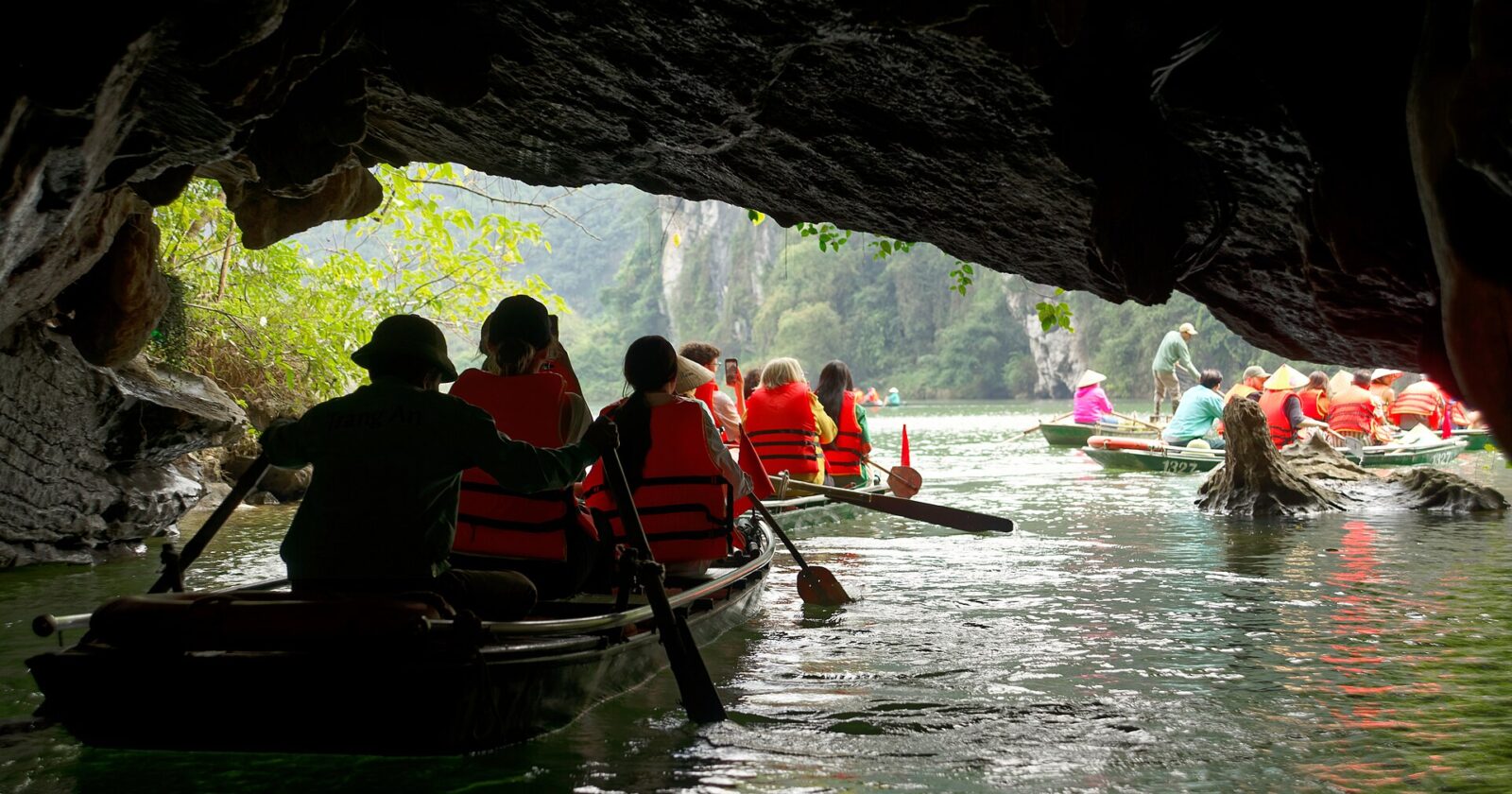
Almost everyone planning Ninh Binh hits the same fork in the road. There are two famous boat trips, a few kilometres apart, both rowed by local boatmen and women along rivers between limestone cliffs, and most people only have time for one. The photos don’t help, because they look alike: a small boat, a conical hat, green water, grey towers. The trips themselves are more different than the pictures suggest, and choosing well comes down to what you want from the day. That’s what this comparison of Trang An vs Tam Coc is for.
Below you’ll find a side-by-side table, a close look at what each trip is actually like, the differences that matter (caves, temples, scenery, time, crowds and money), who should pick which, and how to do both in one day if you can’t choose. Prices come from the Trang An heritage management board’s price list, route details from the Vietnam National Authority of Tourism, and both were checked in November 2026. For the rest of the area, start with our Ninh Binh travel guide.
The Short Answer
Choose Trang An if you can only do one. It’s the longer, more varied trip, with more caves, more temples and the feeling of being rowed deep into a maze of enclosed valleys. It costs 300,000 VND per adult.
Choose Tam Coc if you want the classic rice-field scenery, a shorter trip (about two hours), a slightly cheaper ticket (250,000 VND), or if you’re staying in Tam Coc village and want something on your doorstep. It’s at its best when the rice is green or gold.
Do both if you’re staying a night in Ninh Binh. They really are different enough to justify it.
Trang An vs Tam Coc Side by Side
| Trang An | Tam Coc | |
|---|---|---|
| Adult ticket (2026) | 300,000 VND | 250,000 VND; 350,000 VND with the electric car to Bich Dong |
| Child ticket (1–1.3 m tall) | 150,000 VND | 120,000 VND; 190,000 VND with the electric car |
| Children under 1 m | Free | Free |
| How long | About 2 to 4 hours, depending on the route | About 2 hours, there and back |
| Route | A loop, with a choice of routes | Out and back along the same river |
| Caves | Many, on every route | Three: Hang Ca, Hang Hai and Hang Ba |
| Temples | Several, with stops to get off and look around | Not on the river itself; Thai Vi Temple and Bich Dong Pagoda are nearby, by land |
| Main scenery | Enclosed valleys, cliffs, caves and water | River through rice fields between the cliffs |
| Best season | Year-round, outside floods | When the rice is green, and especially gold, around May |
| Where it starts | Trang An boat wharf | Van Lam wharf, Tam Coc village |
| Hotline | 1900 9251 | 1900 9157 |
| UNESCO | Both are part of the Trang An Landscape Complex, inscribed in 2014 | |
What the Trang An Trip Is Like
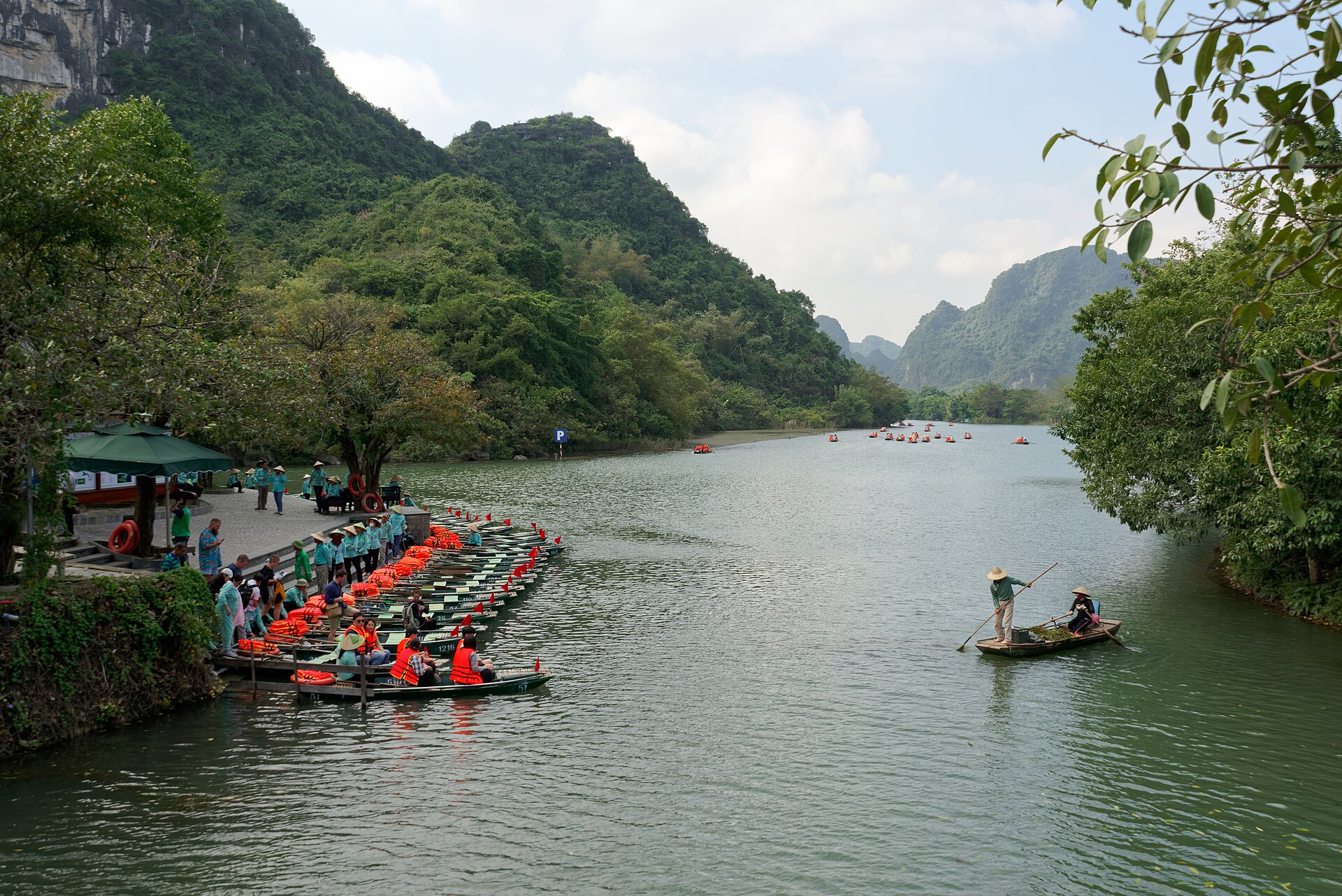
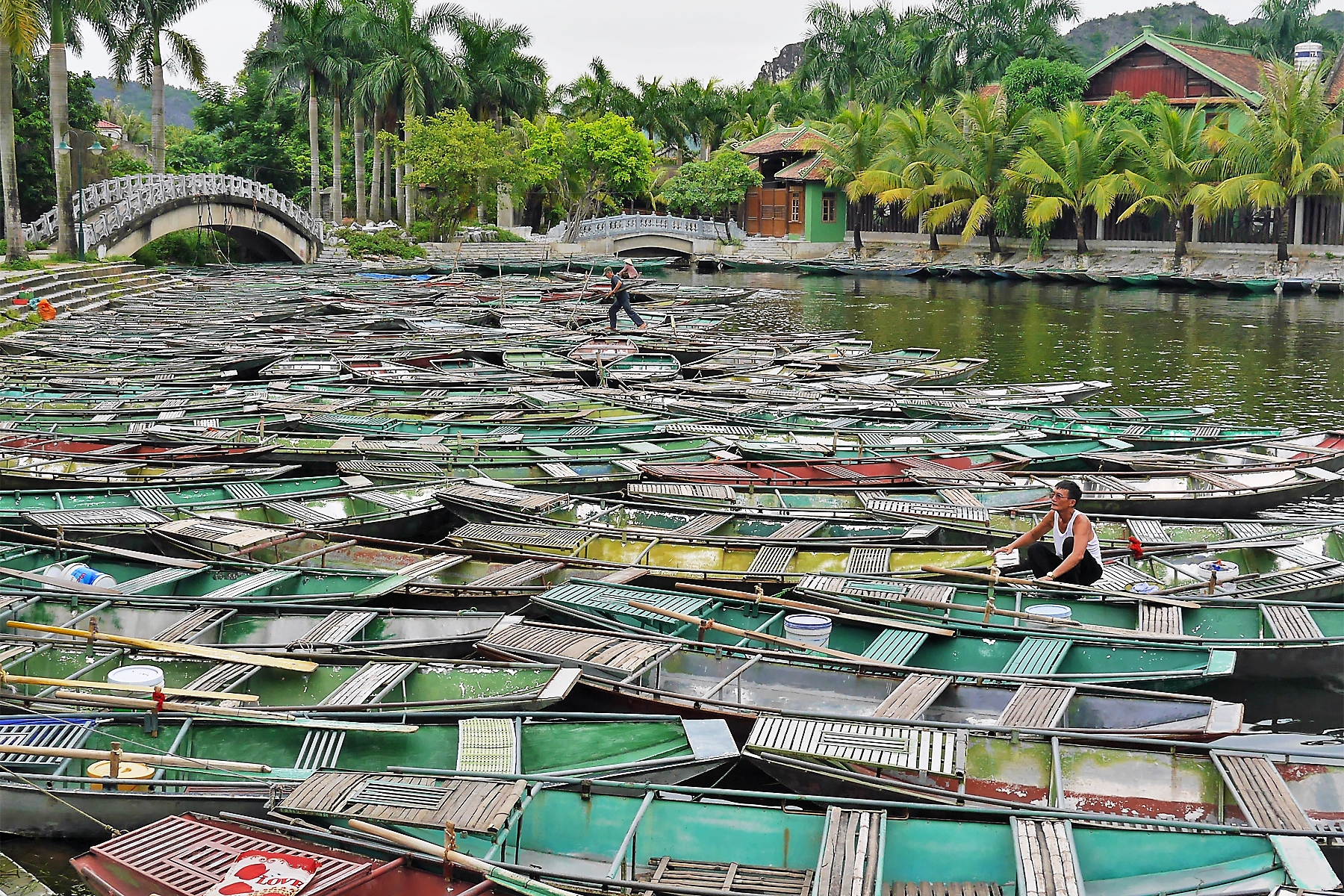
The Trang An boat wharf is a wide basin lined with rows of small boats. You buy a ticket, are pointed to a boat, and set off with your rower and a few other passengers. Within minutes the open water narrows, the cliffs close in, and the river heads straight for a wall of rock. Then you’re in the first cave.
The caves are what make Trang An. Some are short arches you pass through in a minute. Others are long, low tunnels where it’s dark enough that you lose sight of the boat in front, the rower steers by memory, and you duck as the rock passes a few centimetres above your head. Every time you come out, it’s into another enclosed valley, a lake or a river surrounded on all sides by cliffs, with no road and no buildings except the occasional temple on the water’s edge. The boats pull in at several of these temples, and you get off to look around and stretch your legs.
The routes
Trang An’s main boat trip runs on numbered routes, each with its own set of caves and temples. You choose one when you buy your ticket. The Vietnam National Authority of Tourism describes three:
- Route 1 (about 3 to 4 hours): the longest, with the most stops, including Trinh Temple, the Dark and Light caves, Nau Ruou Cave, Tran Temple, Khong Palace, Bao Hieu Pagoda and several more caves.
- Route 2 (about 2 to 3 hours): Lam Cave, Cao Son Temple, Suoi Tien Temple, Dai Cave and Vu Lam Palace, and a filming location from Kong: Skull Island.
- Route 3 (about 3 hours): Trinh Temple, Dot Cave, May (Cloud) Cave, Suoi Tien Temple, Dai Cave and Vu Lam Palace, with one large cave and another Kong location.
Routes are sometimes added, changed or closed, so ask at the ticket office which ones are running and how long each takes on the day. For a first visit, the honest advice is that every route is good; choose by the time you have.
High water
Because Trang An’s routes run through caves, high water in the rainy season can close them. In 2026, route 3 was closed from 31 July until the morning of 2 August when the water in its caves rose too high, while routes 1 and 2 kept running; the board says rising water happens every rainy season. On 9 November 2026 the whole site suspended sightseeing for a day of heavy rain and strong wind. If it has been raining hard, call 1900 9251 before you set off.
What the Tam Coc Trip Is Like
Tam Coc’s boats leave from the Van Lam wharf at the edge of Tam Coc village, where you buy your ticket. The trip follows the Ngo Dong river out through the fields, between the cliffs, and through three caves (Hang Ca, Hang Hai and Hang Ba, the “first, second and third caves”), then turns round and comes back the same way. The Vietnam National Authority of Tourism puts the round trip at about two hours.
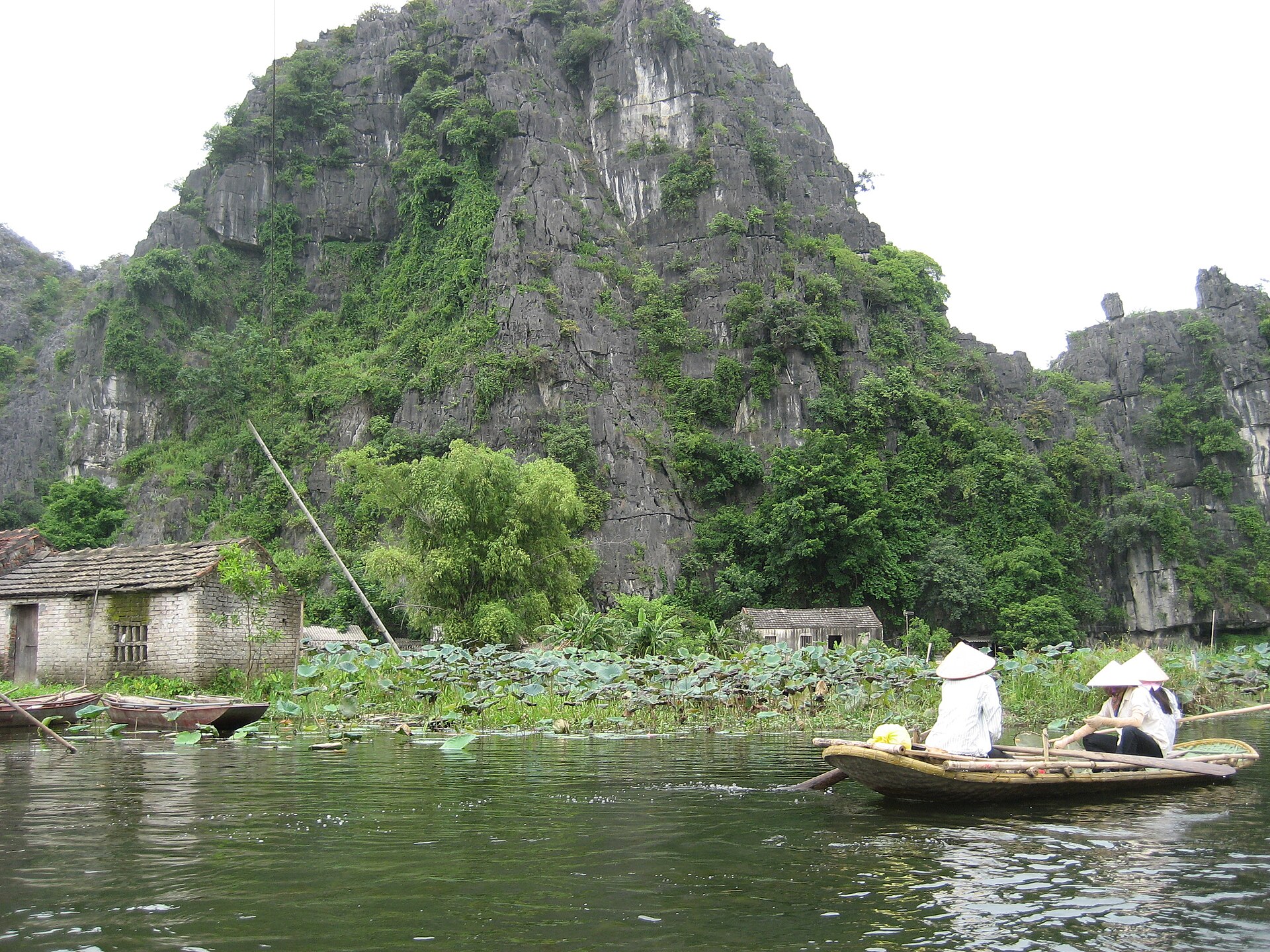
Where Trang An is about enclosure, Tam Coc is about openness. For much of the trip you’re on a river running through flat paddies, with the cliffs standing up on either side. The caves are shorter and fewer, the stops are fewer, and the turnaround point is a busy little gathering of boats before you head back. When the rice is high, and above all when it turns gold before the harvest, it’s a beautiful short boat trip. When the fields are bare, the trip leans more on the cliffs and caves, and it’s still a lovely two hours, but you feel the gap with Trang An more.
Tam Coc’s ticket comes in two versions. The basic one, 250,000 VND, covers the boat. The 350,000 VND ticket adds an electric car that links the Tam Coc boats with Thai Vi Temple, Tien Cave and Bich Dong Pagoda, so you see the temples on land on the same ticket. If you have a bicycle, the basic ticket and a cycle to Bich Dong is just as good.
The Differences That Matter
Caves
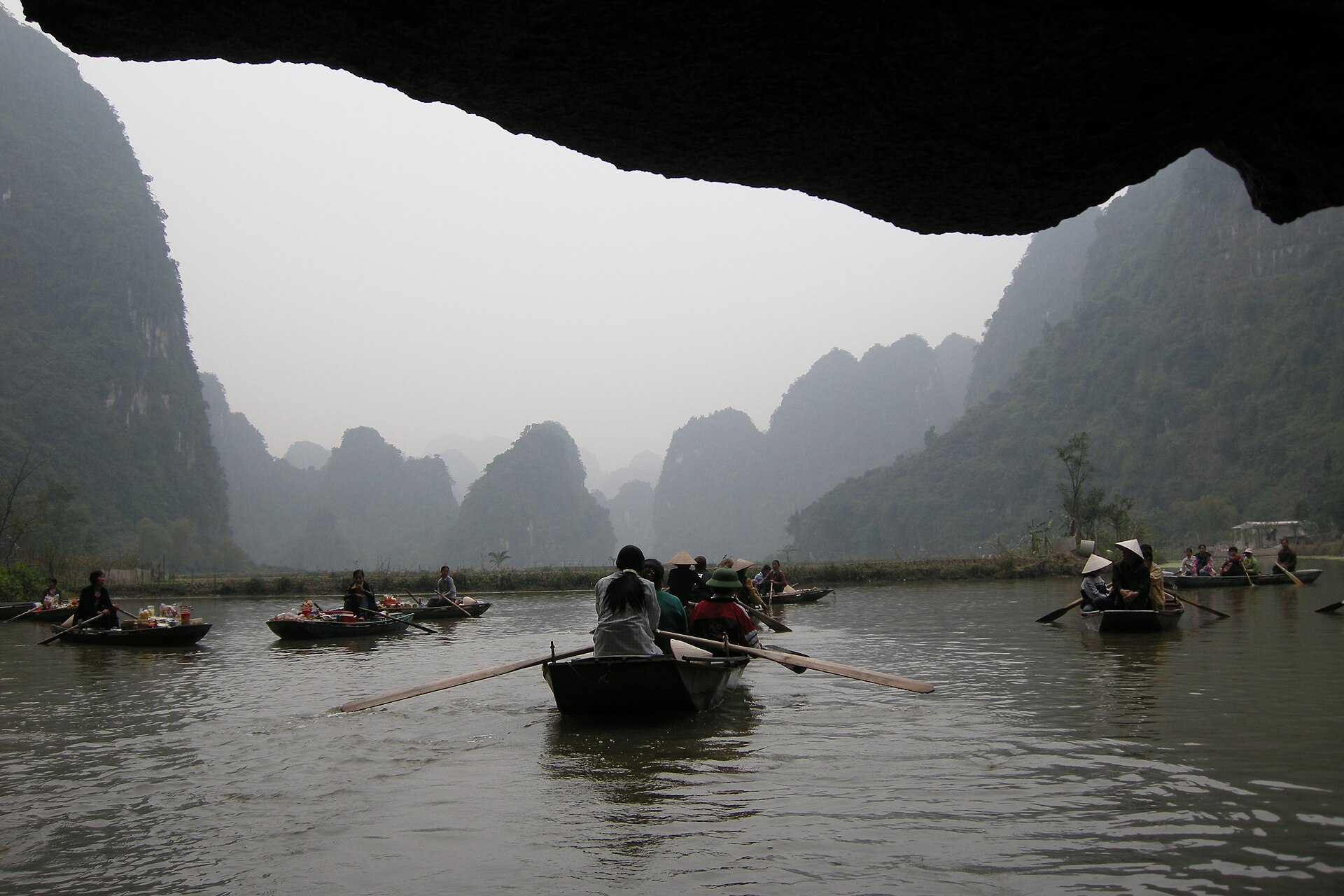
Trang An wins clearly. You’ll go through many caves on any route, and some are long, dark tunnels that are the highlight of the whole trip. Tam Coc has three caves, all on the same river, and you pass through each twice, out and back. If the caves are what you’ve come for, choose Trang An.
Temples and stops
Trang An again. Its routes stop at temples and shrines built on the water, where you get off and wander around. That breaks up the trip and gives you a sense of the spiritual geography of the place. At Tam Coc the boat trip is mainly about the river and its caves; the temples are on land, at Thai Vi and Bich Dong.
Scenery
This is the closest call, and it comes down to taste. Trang An is wilder and more enclosed: water, rock and forest, with very little sign of farming or village life. Tam Coc is more pastoral: rice fields, the odd stone house, the river winding between them. If you’ve seen photographs of a river curving through yellow fields between towers, that was almost certainly Tam Coc, probably from the top of Mua Cave.
Season
Trang An is the safer choice for most of the year, because its scenery doesn’t depend on the rice. Tam Coc is at its peak from around the time the rice ripens. The province has held a Tam Coc “golden season” festival in late May, timed to the ripening rice. Outside the growing seasons, the fields around Tam Coc can be bare, flooded or freshly planted. Trang An is the one more exposed to flooding, though, so in the heaviest rains it’s more likely to close.
Time
Tam Coc is shorter: about two hours. Trang An takes between about two and four hours, depending on the route. On a day trip from Hanoi with only a few hours on the ground, that difference can decide it for you.
Price
Tam Coc is 50,000 VND cheaper per adult, which is a small difference. That’s not a real reason to choose either. If the electric car to Bich Dong appeals, Tam Coc’s combined ticket is 350,000 VND, which is more than Trang An.
Crowds
Both get very busy. Ninh Binh province’s tourism sector reported about 17.6 million visitors in the first half of 2026, up by more than 23% on the same period of 2025, and Trang An is one of the main draws. The crowds are worst from mid-morning to early afternoon, at weekends, on Vietnamese public holidays and in the weeks after Tet. Tam Coc’s river is narrow, so on a busy day it becomes a single line of boats in each direction. Trang An is spread over more water and several routes, so the crowds thin out more once you leave the wharf. Wherever you go, start early.
Vendors and tips
This one is about Tam Coc. On the way back, vendors in their own boats sometimes paddle alongside selling drinks and snacks, and you may be encouraged to buy a drink for your rower. You’re under no obligation, and how you handle it is up to you: a polite “no, thank you” is fine, and so is buying a drink if you want to. Tipping your rower at the end of either trip is not compulsory. If they’ve done a good job, a small tip is a kind gesture, and the decision is yours.
Safety and families
Both trips are gentle, flat-water outings on small, stable boats. At both Trang An and Tam Coc, passengers are required to wear life jackets, and the rowers are local people who do this every day. The main hazard is the low cave ceilings, so keep your head and hands inside the boat in the tunnels. With small children, Tam Coc’s shorter trip is often the better choice: two hours sitting still in a boat is plenty for most under-sevens. Bring hats, sun cream and water for both trips, because there’s little shade on the water.
Which One Should You Choose?
- First time in Ninh Binh, one boat trip only: Trang An.
- Visiting in May: Tam Coc, for the golden rice. Add Trang An if you can.
- Short of time on a day trip: Tam Coc, which is shorter, or Trang An’s shortest route.
- Travelling with small children: Tam Coc, for the shorter trip.
- Love caves: Trang An, route 1 if you have time.
- Want temples too: Trang An, or Tam Coc with the electric-car ticket to Thai Vi and Bich Dong.
- Want peace and quiet: neither, at midday. Go first thing, or consider Van Long (below).
- Staying a night in Tam Coc: both. Tam Coc in the late afternoon and Trang An first thing the next morning, or the other way round.
Can You Do Both in One Day?
Yes, if you start early and are happy with a full day. The Vietnam National Authority of Tourism puts Trang An about 20 minutes from Tam Coc. A realistic plan:
- Early morning: Trang An, on a shorter route, as soon as the wharf opens.
- Late morning: lunch near Trang An or in Tam Coc village.
- Afternoon: the Tam Coc boat.
- Late afternoon: Mua Cave for the view back over the Tam Coc river, if you have the legs for it.
From Hanoi, that’s only realistic with a car and driver and a very early start. It’s much easier with a night in Ninh Binh.
The Quiet Alternative: Van Long
If the thought of a procession of boats puts you off both, consider Van Long. It’s a wetland nature reserve north of the main karst area, where boats glide across shallow, reedy water between the cliffs. It has far fewer caves and temple stops, so it’s not a substitute for Trang An’s variety, but it’s calmer and slower, and you’re more likely to be watching the landscape than the boat ahead. Entry is 100,000 VND for adults; ask at the gate about the boat. Our Ninh Binh guide has more on Van Long and the area’s other quieter corners.
Practical Tips for Either Trip
- Go early. The single best piece of advice for both. The light is softer, the air cooler, and the river quieter.
- Check the weather. After heavy rain, call the Trang An (1900 9251) or Tam Coc (1900 9157) hotline, or ask your hotel, before you set off.
- Bring cash for tickets, drinks and a tip.
- Cover up for temples. Shoulders and knees, at the Trang An temple stops and at Bich Dong.
- Protect your phone. A small dry bag or zip-lock is useful, especially in the rainy season.
- Use a cushion. The seats are low and hard; a folded jacket helps on Trang An’s longer routes.
Trang An vs Tam Coc FAQ
Which is better, Trang An or Tam Coc?
For most people, Trang An: it has more caves, temple stops and variety. Tam Coc is better for rice-field scenery, especially when the rice is golden around May, and it’s shorter.
How much do the Trang An and Tam Coc boat trips cost?
In 2026, Trang An is 300,000 VND per adult and Tam Coc is 250,000 VND, or 350,000 VND with the electric car to Thai Vi Temple, Tien Cave and Bich Dong Pagoda. Children between 1 and 1.3 m tall pay 150,000 VND at Trang An and 120,000 VND at Tam Coc.
How long does each boat trip take?
Tam Coc takes about two hours, there and back. Trang An takes about two to four hours, depending on the route you choose.
Can I do Trang An and Tam Coc on the same day?
Yes. They’re about 20 minutes apart. Start early with Trang An, have lunch, then do Tam Coc in the afternoon. From Hanoi, it’s only realistic with a car and an early start.
Which Trang An route is best?
All are good. Route 1 is the longest, with the most caves and temples; route 2 is shorter. Choose by the time you have, and ask at the ticket office which routes are running.
Is Tam Coc worth it outside rice season?
Yes, but it’s less special. Without the green or gold fields, it’s a pleasant two-hour trip through cliffs and three caves. If you can only do one at that time of year, choose Trang An.
Do I have to tip the rower?
No. A small tip for a rower who’s done a good job is appreciated, but it’s entirely your decision. At Tam Coc, you’re also under no obligation to buy anything from the vendors’ boats.
Do the boat trips close?
Sometimes, in very heavy rain or high water. Trang An’s cave routes are the most affected. Call the hotline before you go if the weather has been bad.
Planning the Rest of Your Ninh Binh Trip
The boat trip is the centre of a Ninh Binh visit, not the whole of it. Our Ninh Binh travel guide covers Mua Cave, Hoa Lu, Bai Dinh and where to stay, and our Ninh Binh day trip guide explains how to fit a boat trip into a single day from Hanoi.
Decided on Trang An? Our Trang An boat tour guide goes through each numbered route cave by cave and temple by temple, with how long it takes and which to choose for a first visit, for small children or for anyone nervous of tight caves.
Related Hanoi Guides
- Ninh Binh Travel Guide
- Ninh Binh Day Trip from Hanoi
- Day Trips from Hanoi
- Ha Long Bay: Day Trip or Overnight?
- Lan Ha Bay vs Ha Long Bay
- Perfume Pagoda from Hanoi
- 7 Days in Hanoi and Northern Vietnam
- Hanoi with Children
Photo Credits
Featured image, boats leaving a cave at Trang An: Trang An Landscape Complex, Ninh Binh Province, Vietnam, 20240202 1403 5212 by Jakub Hałun, CC BY 4.0, via Wikimedia Commons.
Boats at the Trang An wharf: Trang An Landscape Complex, Ninh Binh Province, Vietnam, 20240202 1340 5144 by Jakub Hałun, CC BY 4.0, via Wikimedia Commons.
On the river at Tam Coc: TamCoc-BichDong by Minh Phượng ( Neweco ), CC BY-SA 3.0, via Wikimedia Commons.
A cave mouth on the river: Vietnam, Ninh Binh, Trang An Cave by Vyacheslav Argenberg, CC BY 4.0, via Wikimedia Commons.
Boats at the Van Lam wharf, Tam Coc: Tam Cốc-Bích Động in Ninh Binh province by travel oriented, CC BY-SA 2.0, via Wikimedia Commons.