The ticket windows at the Trang An wharf ask one question that shapes the rest of your day: which route? Take route 1 and you’ll spend a good part of the next three hours ducking through nine caves. Take route 2 and you trade some of that time underground for temples, an enclosed valley and the travelling palace at Vu Lam. Tour groups get whatever their operator booked, and if you’ve arrived on your own it’s easy to pick a number at random. This Trang An boat tour guide is for making that choice on purpose.
Below, each numbered route is laid out stop by stop, with how long it takes, what the trip is like from the ticket office to the last cave, the best time of day to go, and the high-water closures that can change your plans at a day’s notice. Prices are from the Trang An management board’s published price list, checked in November 2026. Dollar figures use Vietcombank’s rate that month, roughly 25,600 to 26,000 VND to the US dollar, and are rounded. If you’re still choosing between Trang An and the shorter Tam Coc trip, start with our Trang An vs Tam Coc comparison. For everything else in the area, see the Ninh Binh travel guide.
The Trang An Boat Tour at a Glance
| What | Details |
|---|---|
| Adult ticket | 300,000 VND (about US$11.50), for anyone taller than 1.3 m |
| Child ticket | 150,000 VND (about US$6) between 1 m and 1.3 m; free under 1 m |
| What it covers | The boat, your rower and one numbered route, with stops to get off at temples |
| Routes | Up to four, taking 1.5 to 3 hours each in the province’s published timings; which ones run depends on the water |
| Price by route | The same ticket whichever route you choose |
| Life jackets | Worn by everyone, for the whole trip |
| Rowers | Local, trained and certified; more than 2,000 work here, most of them women |
| Hotline | 1900 9251 (Trang An management board): call it for the day’s hours, routes and any closure |
| Getting there | Ninh Binh is about two hours from Hanoi by road or rail; Trang An is about 20 minutes from Tam Coc |
How the Trip Works on the Day
Trang An is one big ticketed site, the Trang An Eco-tourism Complex, inside the area UNESCO inscribed on its World Heritage List in 2014 as the Trang An Landscape Complex. It’s a mixed site, listed for both its landscape and its culture, and excavations in its caves have traced people living here for more than 30,000 years. Everything starts at the wharf, a wide basin of water at the foot of the cliffs. You buy your ticket at the ticket office and choose your route as you pay. The price doesn’t change with the route, so the only thing you’re really deciding is which caves and temples you’ll see and how long you’ll be on the water.
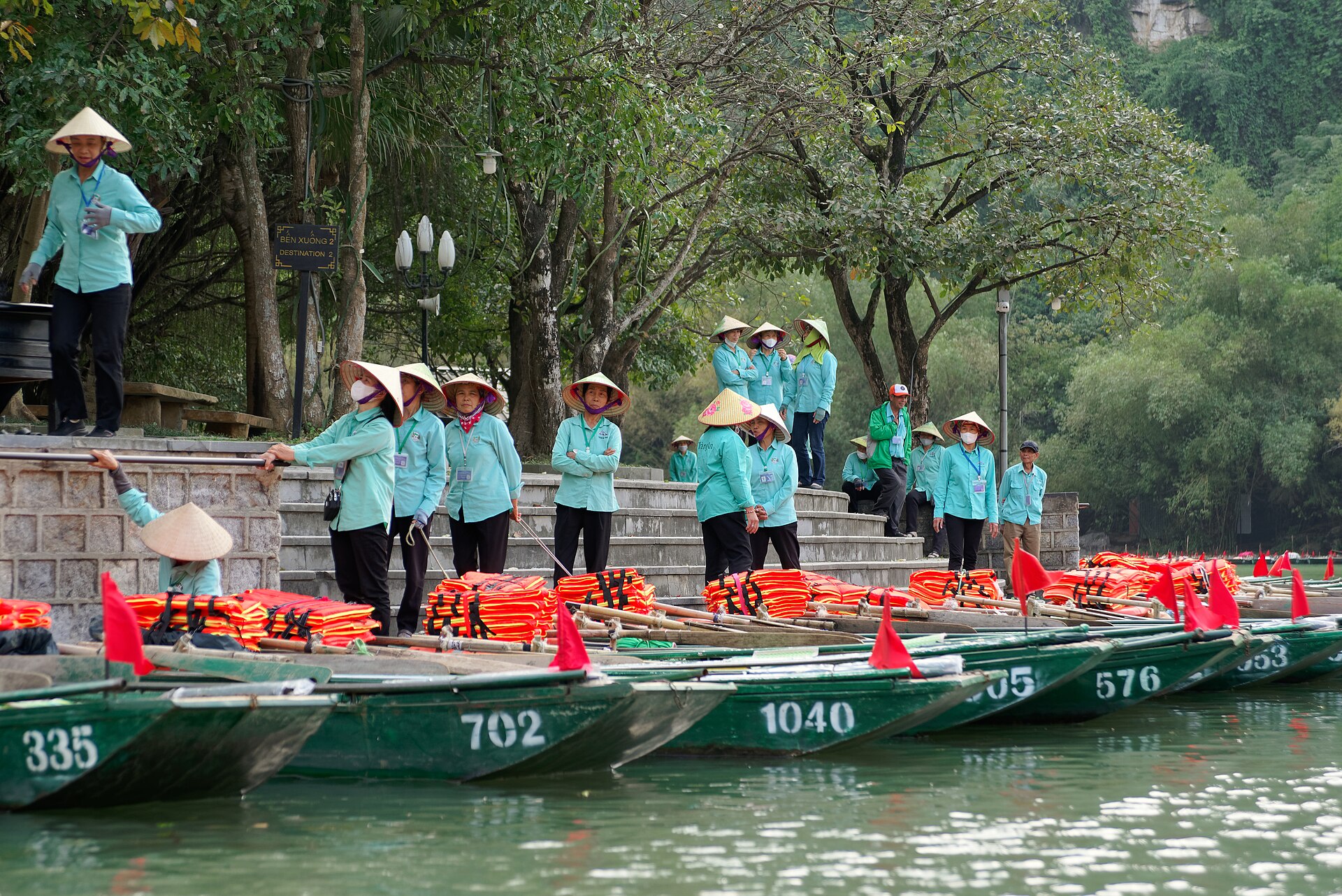
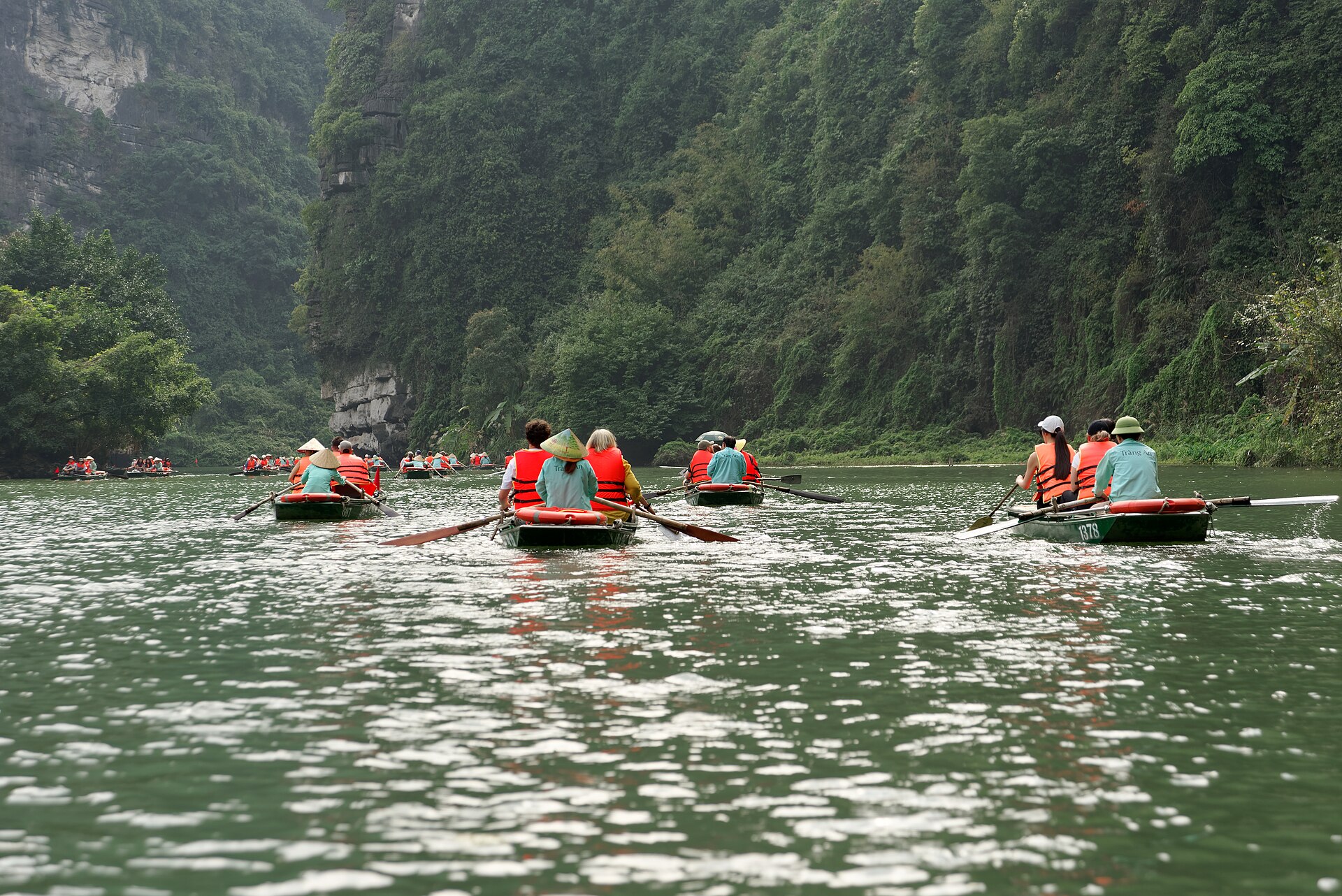
From the ticket office you’re sent down to the boats: long rows of small green rowing boats, each painted with a number, tied up along the steps with orange life jackets piled on the seats. Put yours on before you sit down and keep it on. Life jackets are worn for the whole trip here, and the rowers will remind you if you forget. Everyone wears one, swimmers or not.
Boats are shared. The management board says each one carries only the number of passengers the rules allow, and the staff fill boats to that number, so a couple or a solo traveller will often share with strangers. If you’d rather have a boat to yourselves, ask at the ticket office what that would cost before you pay.
Your rower sits at the back. More than 2,000 rowers work at Trang An, most of them local women, and all of them trained and certified. They row with long oars and point out the caves and temples as they go. Rowing with the feet is usually associated with Tam Coc, but the national tourism authority describes it at Trang An too, so you may see it here too. Three hours of rowing a full boat is hard work, which is worth remembering when you think about a tip.
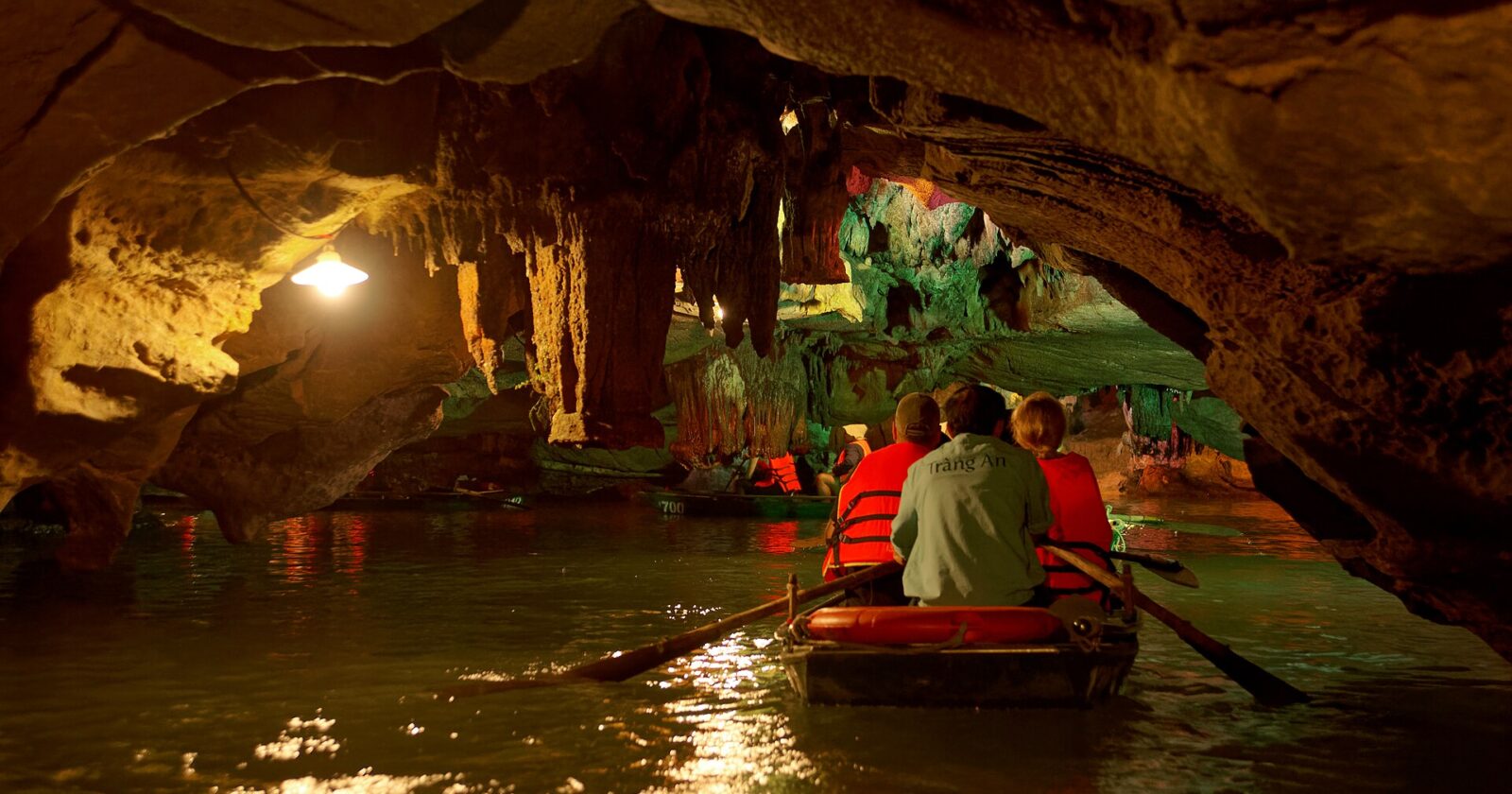
Then come the caves. Some are short arches you’re through in a minute. Others are long, low tunnels where you lean back or duck as the rock passes overhead, and you come out blinking into another valley closed in on every side by cliffs. Some of the caves are lit with lamps along the walls, which pick out the hanging rock and throw reflections across the water. Keep your hands inside the boat; the walls come close.
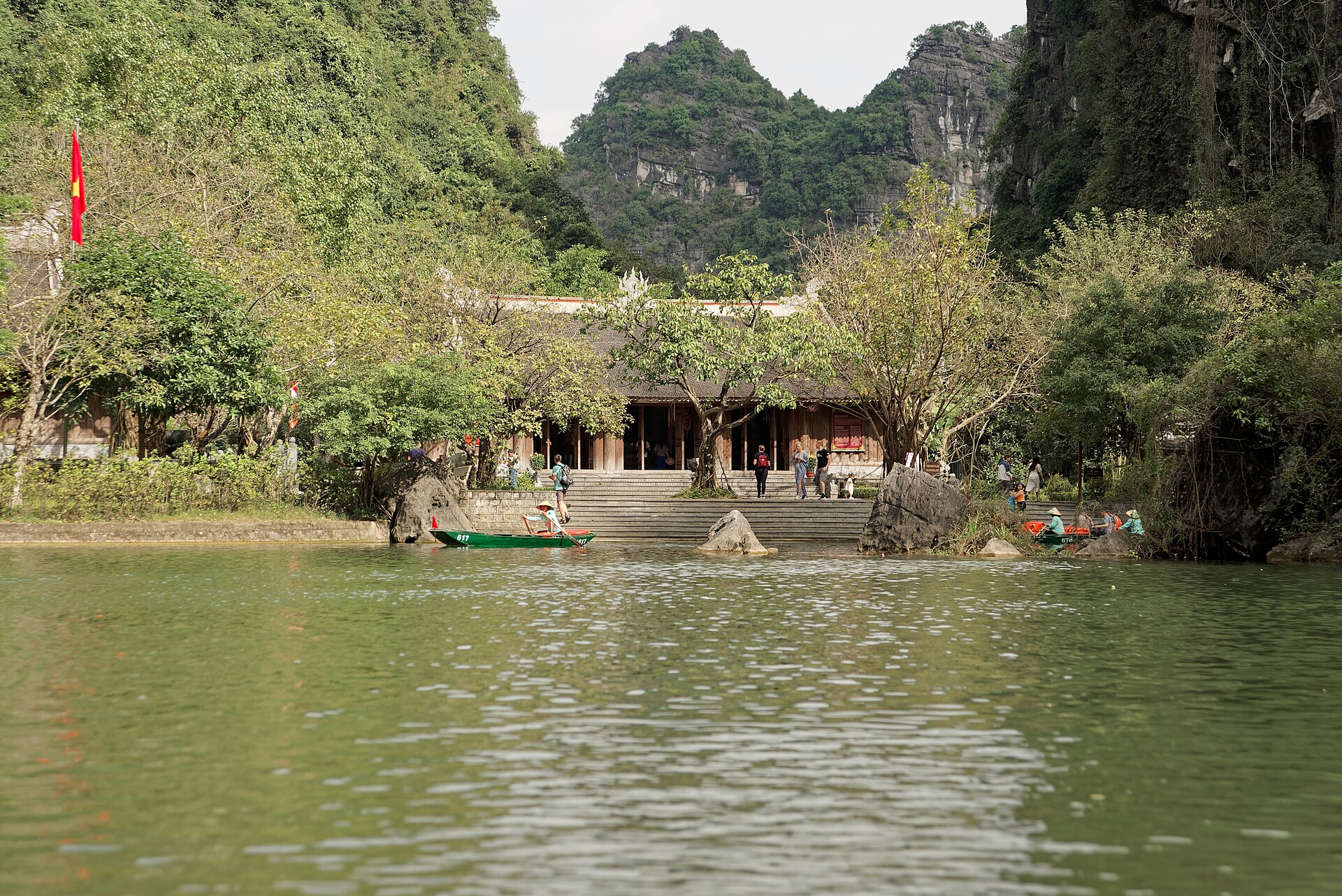
Between the caves, the boats pull in at temples on the water’s edge. Your rower ties up at the landing, you climb the steps to look around, and you come back down to the same boat. How long you spend at each stop is partly up to you, which is one reason the published timings vary.
The Routes Side by Side
Two official descriptions of the routes are in circulation, and they don’t quite agree. Vietnam’s national tourism authority describes three. The Ninh Binh provincial tourism centre’s route page, dated March 2025, lists four, the fourth being a shorter version of route 2. A Trang An rower interviewed by the newspaper Lao Dong in August 2026 put the current number at four, while press reports on that summer’s high water mentioned only routes 1 to 3. So expect up to four, and ask at the ticket office which ones are running when you get there.
| Route | Time (province / tourism authority) | Caves | Temples and other stops | Best for |
|---|---|---|---|---|
| 1 | 3 h / 3–4 h | Toi (Dark), Sang (Light), Nau Ruou, Ba Giot, Seo, Son Duong, Khong, Tran, Quy Hau | Trinh Temple, Tran Temple, Khong Temple | Caves, and most first visits |
| 2 | 3 h / 2–3 h | Lam, Vang, Thang Truot, Dai | Cao Son Temple, Suoi Tien Temple, Voi Valley, Di Linh and Kim Quy mountains, Vu Lam Palace | Temples and open water |
| 3 | 3 h / 3 h | Dot, Van (May), Dai | Trinh Temple, Suoi Tien Temple, Voi Valley, Di Linh and Kim Quy mountains, Vu Lam Palace | One very long cave plus the temples |
| 4 | 1.5–2 h / not listed | Lam, Vang, Thang Truot, Dai | Cao Son Temple, Goc Gao, Vu Lam Palace | Short on time, small children |
The stops are given as the provincial tourism centre lists them. The tourism authority’s lists are close but spell a few names differently (Thanh Truot for Thang Truot, Dia Linh for Di Linh, May Cave for Van Cave), so don’t be thrown if the signs on the water don’t match this table letter for letter.
Route 1: the cave route
Route 1 is the one to take if caves are why you came. The province counts nine of them on this route, plus three temples. You start at Trinh Temple, then go into Hang Toi and Hang Sang, the Dark Cave and the Light Cave, then Nau Ruou Cave, whose name means distilling rice wine. Next is Tran Temple, which the province’s route page calls the heart of the whole complex. After that come Ba Giot, Seo and Son Duong caves, Khong Temple and Khong Cave, and finally Tran and Quy Hau caves.
The rhythm of this route is what makes it: dim tunnel, bright valley, dim tunnel again, with a temple every so often to stretch your legs. It’s the route closest to what most people picture when they think of Trang An, and the tourism authority’s timing of three to four hours makes it the longest. Choose it if it’s your first visit and nobody in your boat minds low ceilings. Skip it if you’re claustrophobic, if you have a toddler who won’t sit still for three hours, or if you’re squeezing Trang An into a day with two other sights.
Route 2: temples and valleys
Route 2 has four caves on the province’s list against route 1’s nine, and puts the time into temples and open water instead. It starts at Lam Cave, a short one, then stops at Cao Son Temple before Vang and Thang Truot caves. Next comes Suoi Tien Temple. The route then passes Voi Valley and the Di Linh and Kim Quy mountains before Dai Cave and the last stop, Vu Lam Palace. Its Vietnamese name, Hanh cung Vu Lam, means a travelling palace: a royal residence away from the capital.
This is the route for people who’d rather see the valleys and temples in daylight than spend the trip underground, and the one we’d pick for anyone nervous about tight caves. The tourism authority times it at two to three hours, the province at three. It’s also, by the tourism authority’s description, one of the routes that passes a Kong: Skull Island filming location. More on what’s left of that below.
Route 3: the long cave
Route 3 starts like route 1, at Trinh Temple, then heads into Dot Cave. The province describes it as the longest and most beautiful cave in Trang An, at over 1,000 m, and on this route it’s the main event. After Van Cave (also called May Cave; both names mean cloud), route 3 joins the second half of route 2: Suoi Tien Temple, Voi Valley, the Di Linh and Kim Quy mountains, Dai Cave and Vu Lam Palace. Both sources give it three hours.
It’s a good route if you want one long cave rather than many short ones, plus the temples. The catch is the water. When the caves flooded in the summer of 2026, route 3 was the one the board shut, from 31 July until the water fell to a safe level. It reopened on the morning of 2 August, and routes 1 and 2 ran throughout. If it has been raining hard, don’t set your heart on it.
Route 4: the short version
Route 4 appears on the province’s list but not in the tourism authority’s description, so ask whether it’s running. On paper it’s a 1.5 to 2-hour cut of route 2: Lam Cave, Cao Son Temple, Vang and Thang Truot caves, a stop at Goc Gao, Dai Cave and Vu Lam Palace. If it’s on offer, it’s the route for small children, tight schedules, and days when you want to fit Bai Dinh, Hoa Lu or Mua Cave around the boat without rushing either.
Temporary routes, and what happened to the Kong set
When the water rises, the board improvises rather than always closing. From 16 September 2026, with water up in several caves, Trang An stayed open on a temporary route instead: from the wharf to Trinh Temple, Ngoc mountain, Vu Lam Palace and a water pavilion. If you arrive after heavy rain and are offered something that isn’t on the table above, that’s why.
As for Kong: parts of Kong: Skull Island were filmed in Trang An, and a set from the film stood here as a visitor attraction from April 2017. It was dismantled in September 2019, following a recommendation from UNESCO. If a tour description promises a stop at “Kong village”, it’s out of date: what’s left is the scenery the film used, not the set.
Which Route Should You Choose?
For a first visit, here’s how we’d rank them, assuming all four are running:
- Route 1. The caves are the point of Trang An, and route 1 has nine of them. No other route here gives you as many. If you only do one boat trip in the region, make it this one.
- Route 3. One very long cave instead of many short ones, plus the temples and valleys of route 2. A close second, as long as the water is low enough for it to run.
- Route 2. Fewer caves, more temples and open water. Better than routes 1 and 3 for anyone who dislikes enclosed spaces, and pleasant for photographers who prefer daylight to cave light.
- Route 4. Only if time is short or you have small children. It’s a good trip, just a shorter version of route 2.
A few cases where the ranking changes:
- You’ve already done Tam Coc. Take route 1. Tam Coc gives you three caves and a lot of rice fields. Route 1 gives you what Tam Coc doesn’t.
- You’re claustrophobic. Route 2 or 4. You’ll still pass through caves, but four rather than nine, starting with a short one.
- You’re with young children. Route 4 if it’s running, otherwise route 2. Three hours is a long time for a five-year-old in a life jacket. Our guide to Hanoi with children has more on pacing day trips with kids.
- It has rained hard for days. Take what’s running. Route 3 was the one closed when the caves filled in July 2026.
- You’re on a day tour. Ask which route the tour uses before you book, and whether you can choose.
When to Go
Time of day
Early. The board’s own advice to visitors is to come earlier or later than the peak, and the difference is real. On 19 February 2026, during the Lunar New Year holiday, nearly 80,000 people came to Trang An and visitors waited 60 to 90 minutes for a boat. Holiday crowds on that scale are the extreme, but ordinary days have a rush hour too. Day tours from Hanoi spend about two hours on the road, so they can’t reach the wharf until well into the morning; get there before them. Be at the ticket office as close to opening as you can manage, which in practice means sleeping in Ninh Binh the night before. In February 2026 the board said it was studying time-slot tickets to spread the crowds, so check the hotline for any change to how tickets are sold.
Late afternoon is the other quiet window, but it leaves less room for a long route before the light goes, so it suits route 2 or 4 better than route 1. Check the day’s last departure with the hotline before you plan around it.
Season and high water
Because the routes run through caves, the water level decides what’s open. The board says the water in the caves rises every rainy season, and 2026 showed what that means in practice: route 3 closed from 31 July to 2 August, a shortened temporary route ran from 16 September, and on 9 November the whole site suspended admission and all sightseeing because of heavy rain and strong wind. The Ninh Binh tourism department warns that opening status, routes and ticket sales can change within a single day. If the weather has been bad, call 1900 9251 before you leave Hanoi, and see our rainy season tips for planning around it.
The cooler months are more comfortable on the open water, where there’s little shade, though a winter morning on the river can be chilly; bring a layer. The December guide covers what to expect from the weather in the north at that time of year.
Festival days and holidays
The Trang An Festival honours Quy Minh Dai Vuong, the guardian of the southern gate of the old Hoa Lu capital. In 2026 it was held on 3 May, the 17th day of the third lunar month. The board calls it an annual festival; check its site for the 2027 date, and expect crowds if your visit coincides. The Lunar New Year holiday and the weeks after it are among the busiest times of year, when pilgrims and day-trippers pack the region’s temples. Our Tet guide explains why the whole country travels then.
Tickets, Children, Guides and Tips
The adult ticket is 300,000 VND (about US$11.50) for anyone taller than 1.3 m. Children between 1 m and 1.3 m pay 150,000 VND (about US$6), and children under 1 m go free. The ticket covers the boat, the rower and your route, and it’s the same price for every route. When crowds on 19 February 2026 left ticket holders unable to board, the board refunded them, which is worth knowing if you’re queuing on a holiday and the line isn’t moving.
With children, the height rule matters more than age, so it’s worth knowing roughly how tall yours are before you reach the window. Every child wears a life jacket. A long route is long, though: pack snacks and something to do, and choose route 4 or 2 if you can.
You don’t need a guide. If you’d like one, ask at the ticket office whether a guide is available and what it costs. A guide earns their fee on route 1, where the stories behind the temples and caves are half the interest.
Tipping is the question everyone asks. The ticket price covers your rower, and a tip is up to you. If yours rowed well, pointed things out and waited patiently at every temple, a tip at the end of the trip is a kind way to say thank you. Our tipping guide covers how tipping works in Vietnam more generally.
Getting to the Trang An Wharf
Ninh Binh is about 90 to 100 km south of Hanoi, and the national tourism authority puts the trip at about two hours by road or rail. The provincial tourism portal lists buses from Giap Bat, My Dinh and Nuoc Ngam stations at 80,000 to 150,000 VND (about US$3 to US$6), taking 1.5 to 2 hours, though Hanoi traffic can easily add more. Trains run to Ninh Binh station, with economy seats from 90,000 to 150,000 VND (about US$3.50 to US$6). From the bus or train you’ll need a taxi or a hotel transfer to the wharf. Our Ninh Binh day trip guide compares the options in detail, with a realistic timetable for doing it all in one day.
If you’re staying in Tam Coc, the national tourism authority puts Trang An about 20 minutes away. You can rent a motorbike in Ninh Binh for 100,000 to 150,000 VND (about US$4 to US$6) a day, according to the provincial portal; read our motorbike rental guide first for the licence and insurance questions. A car with a driver is the easy option for families, and the most practical way to reach the wharf early if you’re coming from Hanoi the same morning.
What to Bring
- A hat and sun cream. Most of the trip is on open water, with little shade.
- Water. Three hours is a long time to be thirsty.
- A light rain jacket or poncho, and a dry bag or zip-lock for your phone. The caves drip.
- A layer in winter. Mornings on the river can be cool from December to February.
- Something soft to sit on if you’re particular about damp seats.
- Some cash, if you’d like to tip your rower.
Use the toilet before you board. Wear shoes you can climb temple steps in, and keep your bag small enough to hold on your lap. Our Hanoi packing list covers the rest of the trip.
Is the Trang An Boat Tour Worth It?
Yes. Being rowed through a tunnel under a mountain and out into a valley walled in by cliffs is, in our view, the best thing to do in Ninh Binh. But three things can spoil it, and all three are avoidable. The first is the crowd: a holiday morning with a 90-minute queue and boats nose to tail is a different and much worse trip, so go early and avoid public holidays. The second is the weather: the day after heavy rain, the best routes may be shut. The third is choosing blind. Most disappointment with Trang An comes from someone who wanted caves getting route 2, or someone with a restless child getting three hours of route 1.
It isn’t for everyone. If sitting still in a small boat for two or three hours sounds like a chore, take the shorter Tam Coc trip, or skip the boats and cycle the lanes around Tam Coc instead. Nobody should feel obliged to do both boat trips in one day.
Trang An Boat Tour FAQ
Which Trang An route is best?
For most first-time visitors, route 1: it has nine caves on the province’s list, more than any other route, and caves are what make Trang An special. Route 3 is a close second for its one very long cave. Choose route 2 if you’d rather see temples and valleys than spend the trip underground, and route 4, if it’s running, when time is short or you have small children.
How long is the Trang An boat tour?
About 1.5 to 3 hours on the province’s figures, depending on the route; the national tourism authority gives route 1 three to four hours and route 2 two to three. Time at the temple stops is partly up to you, so the same route can run shorter or longer.
How much does the Trang An boat tour cost?
300,000 VND (about US$11.50) per adult taller than 1.3 m, and 150,000 VND (about US$6) for children between 1 m and 1.3 m. Children under 1 m go free. The price is the same for every route and includes the boat and the rower.
Can you choose your route?
Yes, when you buy your ticket, from whichever routes are running that day. On a tour, ask which route is included before you book.
Do the Trang An routes close in the rainy season?
They can. The board says the water in the caves rises every rainy season. In 2026, route 3 closed from 31 July to 2 August, a shortened temporary route ran from 16 September, and the whole site suspended sightseeing on 9 November for heavy rain and wind. Call the board’s hotline, 1900 9251, before you set off if the weather has been bad.
Is the Kong: Skull Island set still at Trang An?
No. Parts of the film were shot here, and a set stood as a visitor attraction from April 2017, but it was dismantled in September 2019 following UNESCO’s recommendation. The tourism authority still mentions Kong filming locations on routes 2 and 3; what you’ll see there is scenery, not a set.
Do you tip the rower at Trang An?
It’s up to you. The ticket covers the rower. A tip at the end for a rower who did a good job is a kind gesture, but you’re under no obligation.
Is the Trang An boat trip suitable for children?
Yes, with the right route. Everyone wears a life jacket, children under 1 m go free, and those between 1 m and 1.3 m pay half price. Choose route 4 or route 2 for young children, and pack snacks.
Planning the Rest of Your Ninh Binh Trip
The boat trip is the centre of a Ninh Binh visit, not the whole of it. Our Ninh Binh travel guide covers Hoa Lu, Bai Dinh, Mua Cave and where to stay, and the Mua Cave guide covers the climb that gives you the view over the river you’ve just been rowed along.
Related Hanoi Guides
- Ninh Binh Travel Guide
- Trang An vs Tam Coc
- Mua Cave Guide
- Ninh Binh Day Trip from Hanoi
- Day Trips from Hanoi
- Hanoi with Children
- 7 Days in Hanoi and Northern Vietnam
Photo Credits
Boat in a lamp-lit cave at Trang An (featured image): Trang An Landscape Complex, Ninh Binh Province, Vietnam, 20240202 1413 5244 by Jakub Hałun, CC BY 4.0, via Wikimedia Commons.
Rowers and numbered boats at the Trang An wharf: Tour boats at Trang An Landscape Complex, Ninh Binh Province, Vietnam, 20240202 1346 5149 by Jakub Hałun, CC BY 4.0, via Wikimedia Commons.
Temple stop at the water’s edge: Trang An Landscape Complex, Ninh Binh Province, 20240202 1410 5232 by Jakub Hałun, CC BY 4.0, via Wikimedia Commons.
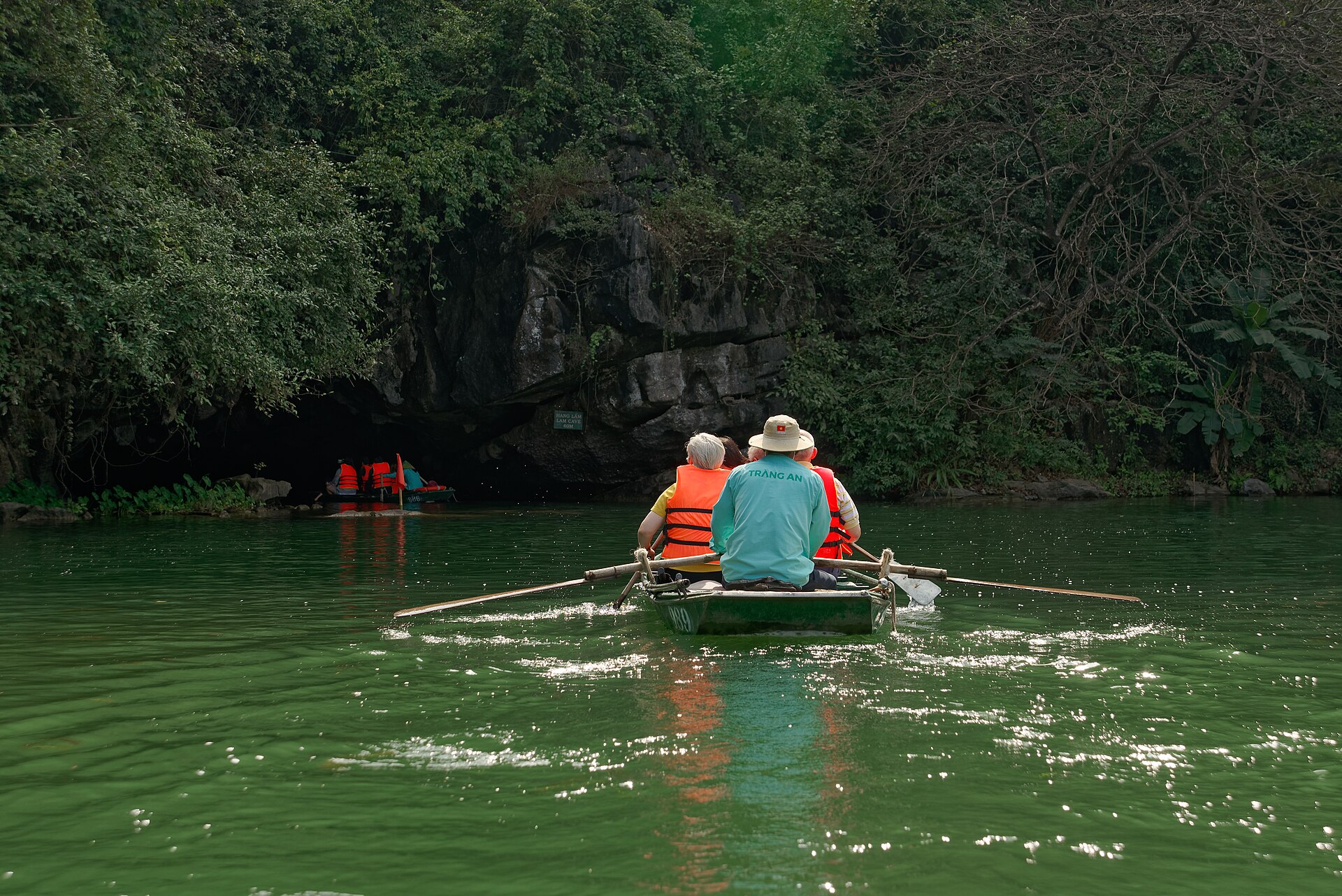
Boat approaching Lam Cave: Trang An Landscape Complex, Ninh Binh Province, Vietnam, 20240202 1353 5165 by Jakub Hałun, CC BY 4.0, via Wikimedia Commons.
Boats on the river between the cliffs: Trang An Landscape Complex, Ninh Binh Province, Vietnam, 20240202 1404 5216 by Jakub Hałun, CC BY 4.0, via Wikimedia Commons.