
The first thing most people notice on the Tam Coc boat ride isn’t the cliffs. It’s the rower behind them, leaning back and working the oars with their feet. The second thing, for some passengers, comes near the end: a quiet word about a tip before the boat reaches the wharf. Both are part of the trip, and knowing about them in advance is most of what separates a lovely two hours from an awkward one. This Tam Coc boat ride guide covers both, along with everything else you’ll want to know before you step into the boat.
It explains the two tickets and which one to buy, how the boats and rowers work, what you’ll see in the three caves, the vendor boats and the tipping question, when the rice is worth timing your visit for, and how to get there. Prices come from the management board’s published price list, checked in November 2026. Dollar figures use Vietcombank’s rate that month, roughly 25,600 to 26,000 VND to the US dollar, and are rounded. If you haven’t yet decided between Tam Coc and Trang An, our Trang An vs Tam Coc comparison will help, and the Ninh Binh travel guide covers the rest of the region.
The Tam Coc Boat Ride at a Glance
| What | Details |
|---|---|
| Boat ticket | 250,000 VND (about US$10) per adult taller than 1.3 m |
| Boat plus electric car | 350,000 VND (about US$13.50), adding Thai Vi Temple, Tien Cave and Bich Dong Pagoda |
| Children | 120,000 VND, or 190,000 VND with the electric car, between 1 m and 1.3 m; free under 1 m |
| Where to board | Van Lam wharf, in Nam Hoa Lu ward |
| The route | Along the Ngo Dong river through three caves, Hang Ca, Hang Hai and Hang Ba, and back the same way |
| How long | About two hours for the round trip |
| Who shares a boat | Two or four passengers, plus your rower |
| Life jackets | Worn for the whole trip |
| Tips | Not part of the ticket, and your choice |
| Hotline | 1900 9157, for the day’s hours and any weather closure |
Buying Your Ticket at Van Lam Wharf
The boats leave from Van Lam wharf, at the edge of Van Lam village in the Tam Coc-Bich Dong area. Since the 2025 reorganisation of local government, the management board gives the area’s address as Nam Hoa Lu ward, about 7 km from the centre of Hoa Lu ward, the provincial capital, and 2 km from National Highway 1.
There are two tickets for the main boat trip, and the difference between them has nothing to do with the boat:
- Boat only: 250,000 VND (about US$10) per adult. Children between 1 m and 1.3 m pay 120,000 VND (about US$4.50), and children under 1 m go free.
- Boat and electric car: 350,000 VND (about US$13.50) per adult, 190,000 VND (about US$7.50) for children between 1 m and 1.3 m. The electric car links the Tam Coc boats with Thai Vi Temple, Tien Cave and Bich Dong Pagoda, so you see the temples on land on the same day without arranging your own transport. More on whether it’s worth the extra below.
Call the hotline, 1900 9157, to check the day’s hours if you’re planning a very early or late start, and ask at the wharf when you arrive. The same hotline is the place to check after heavy rain or a storm warning. Tam Coc’s boats stop in storms and dangerous weather, and the board announces suspensions through its official channels.
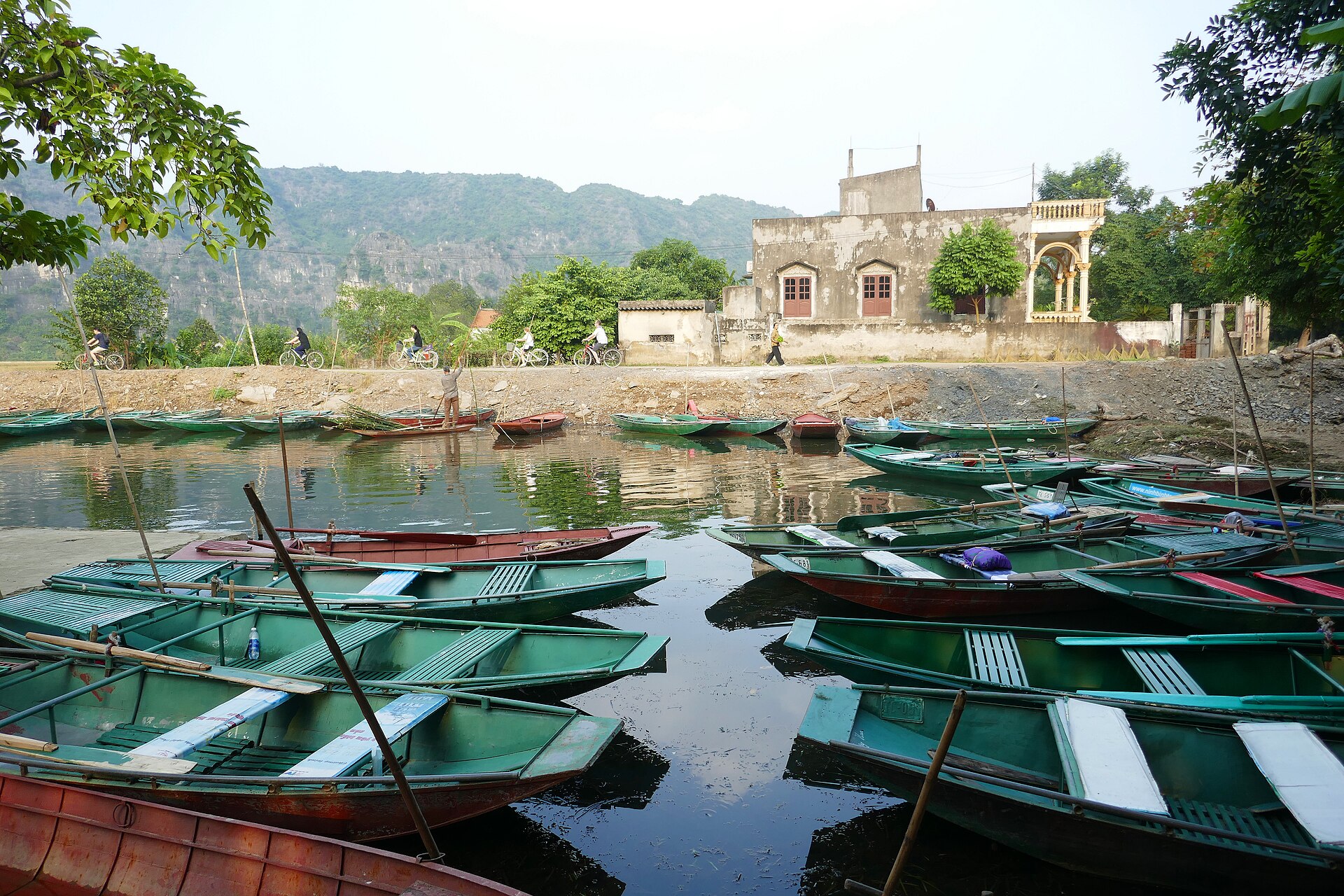
Boats are shared. The national tourism authority says two or four passengers share a boat, and the staff at the wharf will tell you which. So a couple may have the boat to themselves or share it with another pair. Everyone wears a life jacket for the whole trip.
The management board also lists two other boat routes in the Tam Coc-Bich Dong area: one through the water cave beneath Bich Dong, and one from Thach Bich to Thung Nang. If you’re curious, ask at the wharf whether they’re running and what they cost.
Your Rower and the Foot-Rowing
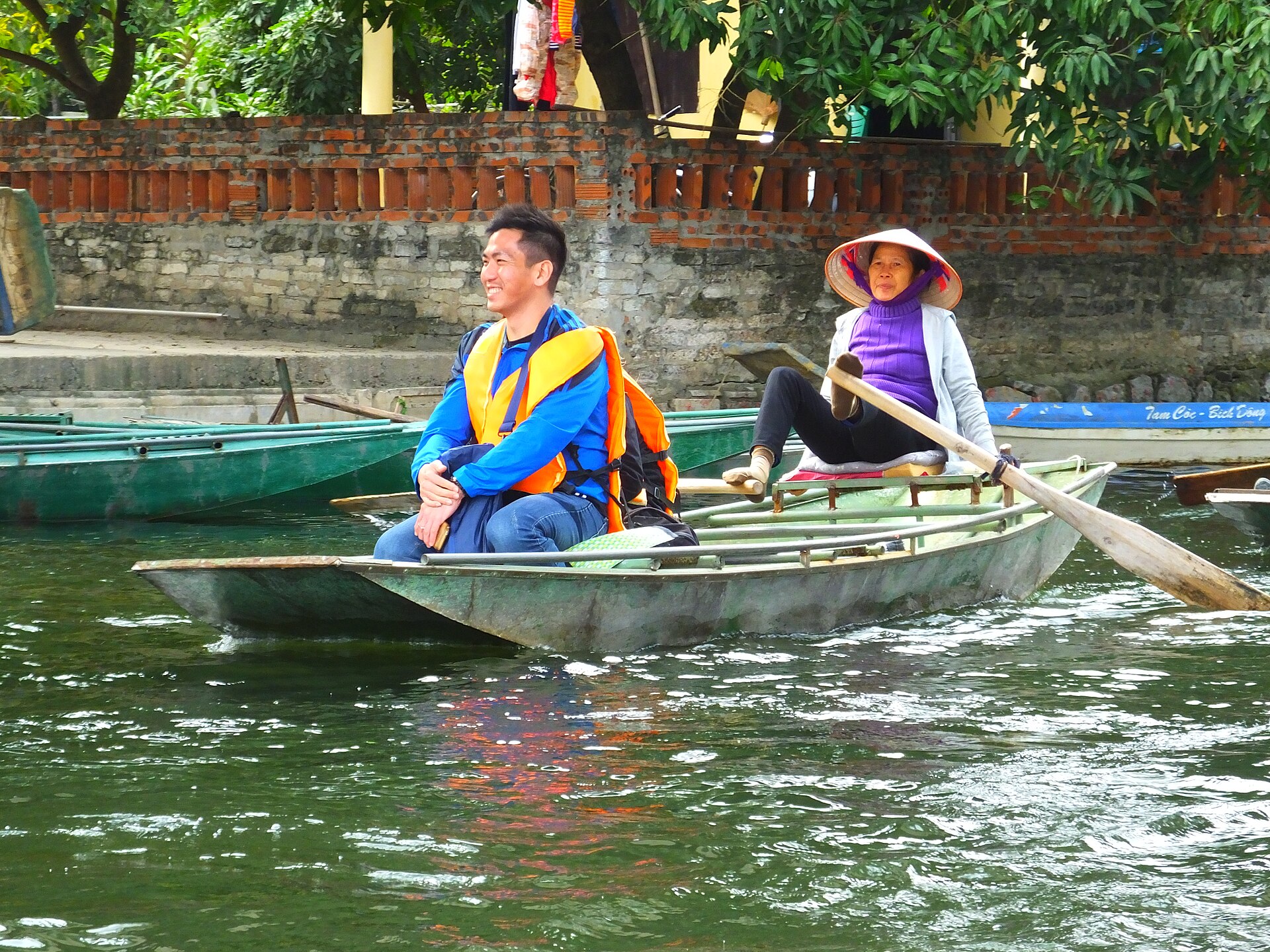
Your rower sits at the back of the boat. On a long, flat stretch of the Ngo Dong, there’s a good chance you’ll see the technique Tam Coc is known for: the rower leans back and works the oars with their feet, pushing the boat along with their legs. The national tourism authority says the technique developed to lessen the strain on rowers’ hands, arms and backs, and that you’ll see it at Trang An as well as Tam Coc. It looks effortless. It isn’t, and two hours of it is a long shift.
Van Lam, the village at the wharf, is also an embroidery village. The board’s own site describes its lace and embroidery, a craft local tradition traces back to the Tran dynasty, and you can watch it being made in the village. You may also be offered embroidery in the boat itself. Look if you’re interested and say no if you’re not; nobody should hold that against you.
The Route: The Ngo Dong River and the Three Caves
Tam Coc means “three caves”, and the trip is built around them. From Van Lam wharf the boat follows the Ngo Dong river out between the fields, with limestone cliffs rising on either side. The national tourism authority names the caves in order as Hang Ca, Hang Hai and Hang Ba: literally the eldest, the second and the third. The river runs straight through each one, so the boat goes in at one side of a mountain and comes out at the other.
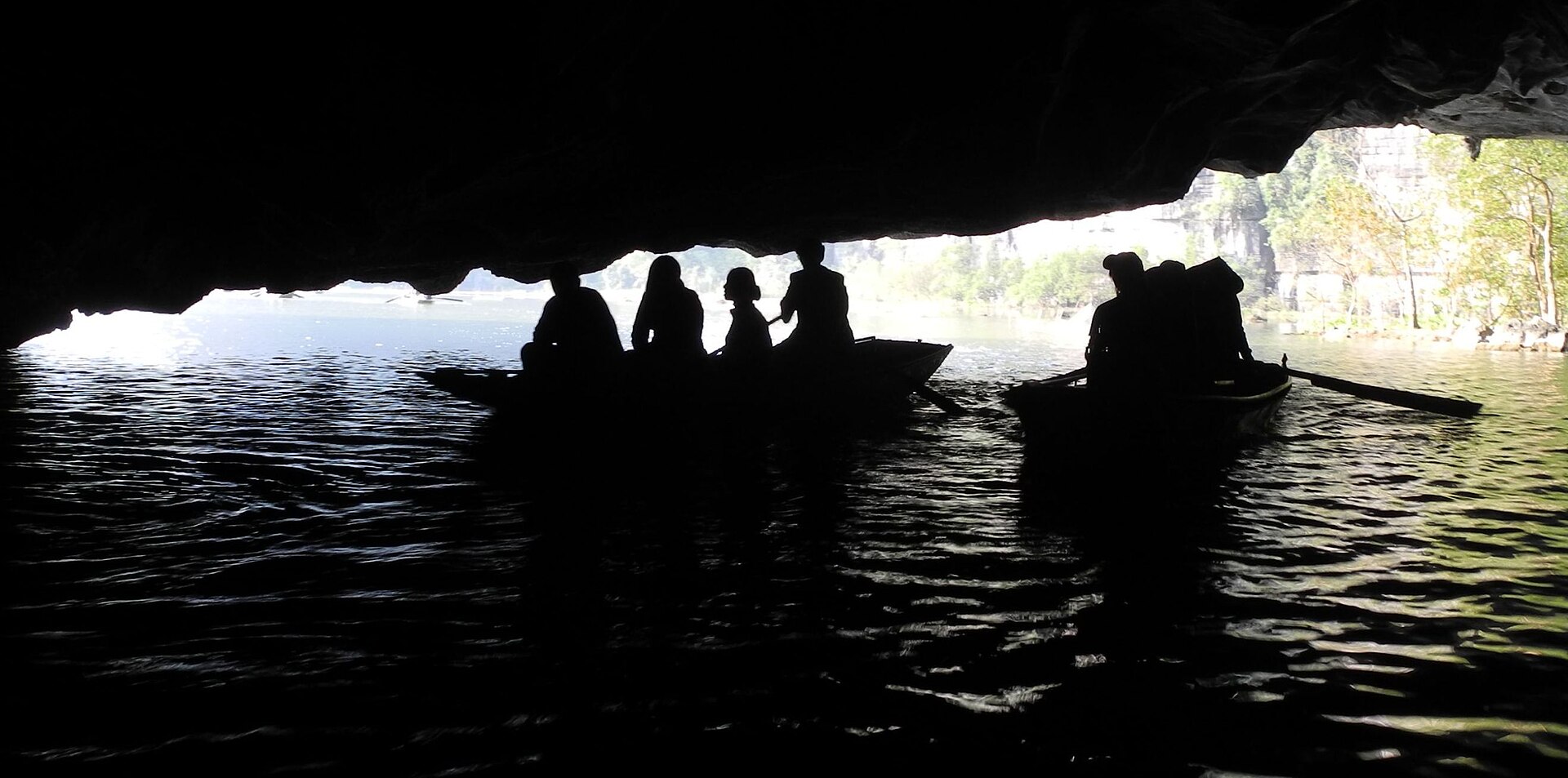
The caves are low and dark in places. You’ll lean back or duck as the roof comes down, while the light at the far end grows. Then you’re out into the open again, with paddies and cliffs and the next mountain ahead. After the third cave the boats turn round, and you come back the same way, through the same three caves, to the wharf. The tourism authority puts the round trip at about two hours.
That out-and-back shape is the trip’s one structural weakness. On the way out, everything is new. On the way back, you’ve seen it, the sun is higher and the boats are thicker on the water, which is why the stretch after the turnaround is where the selling and the tip conversations tend to happen. It’s also why an early start matters at Tam Coc.
The Vendor Boats and the Tipping Question
This is the part people ask about, so here it is plainly.
The vendor boats. On the way back, vendors in their own boats sometimes paddle alongside selling drinks and snacks, and you may be encouraged to buy something for your rower. You’re not obliged to. A polite “no, thank you” (or “không, cảm ơn”) is enough, and if you’d like a drink, or you’d like to buy one for your rower, that’s fine too. Know that it’s a sale, not a custom.
Tips. Your ticket pays for the boat and the rower. A tip is extra, and it’s up to you. If you tip, let it be because your rower worked hard, rowed with their feet for two hours and got you through the caves without a bump. What a tip shouldn’t be is something you’re pressured into.
That pressure does happen. In November 2026, a tour guide’s account of a Tam Coc rower who followed tourists ashore after a trip on 14 November and held on to them to demand a tip was reported in the Vietnamese press. The same account described rowers stopping short of the wharf to ask for “money” and a tip. The guide said they had no objection to tips given willingly, only to the pressure. On 17 November, Ninh Binh’s Department of Culture, Sports and Tourism said it was verifying the case and would deal with any violations it found.
It needn’t spoil your trip. A little preparation takes the awkwardness out of it:
- Decide before you board whether you’ll tip and roughly how much, and keep that amount in small notes in a separate pocket, so you’re not opening a full wallet in a small boat.
- Tip at the end, on the wharf, not halfway back, if a tip is what you’d like to give.
- Say no calmly if you don’t want to buy or tip. You don’t owe an explanation.
- Note the number painted on your boat if anything goes beyond a polite request, and report it to the board’s hotline, 1900 9157.
Our tipping guide explains how tipping works in Vietnam more generally, and our guide to common scams covers the wider habit of being steered into purchases.
When to Go
Time of day
As early as you can. Tam Coc’s river is narrow, so on a busy day the boats form a single line in each direction. Day tours from Hanoi spend about two hours on the road, so the earliest boats leave before they arrive. If you’re staying in Tam Coc village, be at the wharf when it opens. You’ll have cooler air, softer light and an emptier river, and you’ll be back before the heat of the day. Late afternoon is the other gentle time, but check the last departure with the hotline before you plan around it.
The rice
The Tam Coc boat trip changes with the seasons, because so much of it runs between rice fields. The management board says the rice along the Ngo Dong starts to ripen from mid-May, and calls that the best-looking time of year. In 2026 the province held a Tam Coc golden-season festival on the morning of 24 May, during Ninh Binh Tourism Week, which opened the evening before. For any 2027 festival dates, check the Ninh Binh tourism department’s announcements.

Outside the ripening weeks, depending on the month, the fields are flooded, newly planted, green or harvested and bare. The trip is still worth doing then; the cliffs and caves don’t change. But if you’ve seen photos of boats gliding through gold and that’s what you’ve come for, time your visit for late May. In a bare-field month, the trip leans more on the karst and the caves, and you’ll notice the gap with Trang An more.
Rain, storms and holidays
The boats stop for storms and dangerous weather. If heavy rain or a typhoon warning is in the forecast, call 1900 9157 before you set off. Our rainy season tips cover planning a trip around northern Vietnam’s wet months. Weekends and public holidays are the busiest days, and the weeks after Tet bring pilgrims to the province’s temples, so if you can, go on a weekday.
Is the 350,000 VND Ticket Worth It?
The extra 100,000 VND (about US$4) buys you an electric-car connection from the Tam Coc boats to three sights on land: Thai Vi Temple, Tien Cave and Bich Dong Pagoda.
- Thai Vi Temple honours the first kings of the Tran dynasty and the generals who led the resistance to the Mongol invasions of the 13th century. According to the management board, after the first victory over the Mongols, in 1258, King Tran Thai Tong handed the throne to his son and withdrew to the mountains of Truong Yen, where he built the Vu Lam palace and the Thai Vi hermitage. The temple was ranked a national historic and cultural relic in 1994, and its festival falls on the 15th day of the third lunar month.
- Bich Dong Pagoda is three pagodas in one, the lower, middle and upper pagodas, climbing the side of Ngu Nhac Mountain. It’s a quiet, lovely place with views back over the fields, and well worth the climb.
- Tien Cave is the other stop on the electric-car route.
Our verdict: if you don’t have a bicycle or motorbike, the 350,000 VND ticket is worth it, because Bich Dong alone repays the extra 100,000 VND and the electric car spares you arranging transport. If you’re staying in Tam Coc village and have a bicycle, buy the 250,000 VND boat ticket and cycle to Bich Dong. The ride through the fields is half the pleasure.
Getting to Tam Coc
Ninh Binh is about two hours from Hanoi by road or rail, according to the national tourism authority. The provincial tourism portal lists buses from Giap Bat, My Dinh and Nuoc Ngam stations at 80,000 to 150,000 VND (about US$3 to US$6), taking 1.5 to 2 hours plus Hanoi traffic, and economy train seats to Ninh Binh station at 90,000 to 150,000 VND (about US$3.50 to US$6). From the bus or train, take a taxi or a hotel transfer to Tam Coc. Our Ninh Binh day trip guide compares every option, with a realistic timetable for doing it in a day.
Once you’re in the area, Tam Coc is about 20 minutes from Trang An, according to the national tourism authority, and close to Mua Cave, whose summit looks down on the Ngo Dong valley. The provincial portal lists motorbike rental at 100,000 to 150,000 VND (about US$4 to US$6) a day; read our motorbike rental guide first.
Is the Tam Coc Boat Ride Worth It?
Yes, with conditions. At its best, in the early morning with the rice green or gold and a rower working the oars with their feet, it’s a beautiful two hours, and it’s cheaper than Trang An. At its worst, on a holiday afternoon with bare fields, a crowded river and a tip request at the wharf, it feels like a production line.
So go early, go in late May if you can, decide about tipping before you board, and treat the vendor boats as a shop you can walk past. If you only have time for one boat trip in Ninh Binh and you’re not coming for the rice, choose Trang An instead: our Trang An boat tour guide explains its routes. If you’re staying in Tam Coc village anyway, the boat ride on your doorstep is an easy yes.
Tam Coc Boat Ride FAQ
How long is the Tam Coc boat ride?
About two hours for the round trip, according to the national tourism authority: out along the Ngo Dong river through three caves, then back the same way.
How much is the Tam Coc boat ride?
250,000 VND (about US$10) per adult for the boat, or 350,000 VND (about US$13.50) with the electric car to Thai Vi Temple, Tien Cave and Bich Dong Pagoda. Children between 1 m and 1.3 m pay 120,000 or 190,000 VND, and children under 1 m go free.
Do you have to tip at Tam Coc?
No. The ticket pays for the boat and the rower, and a tip is your choice. If you want to tip, do it at the end. If a rower pressures you, note the boat number and call the board’s hotline, 1900 9157. In November 2026, Ninh Binh’s tourism department said it was verifying a reported case of a rower demanding a tip.
Why do Tam Coc rowers use their feet?
To spare their hands, arms and backs, according to the national tourism authority. Rowers lean back and push the oars with their feet, resting their arms. You’ll see the technique at Trang An too.
When is the rice golden at Tam Coc?
The management board says the rice starts to ripen from mid-May. In 2026 the province held a golden-season festival on 24 May, during Ninh Binh Tourism Week; check the tourism department’s announcements for 2027.
Is Tam Coc worth it outside rice season?
Yes, but it’s a different trip. The caves and cliffs are the same all year, but without green or golden rice the scenery leans more on the karst. If you’re not here for the rice and only have time for one boat trip, Trang An is the better choice: its route 1 takes in nine caves.
Can you take the Tam Coc boat in the rain?
The boats stop in storms and dangerous weather. In lighter rain, bring a rain jacket, and call 1900 9157 before you set off if you’re unsure.
Is the 350,000 VND ticket worth it?
If you don’t have your own transport, yes: the electric car takes you to Bich Dong Pagoda, Thai Vi Temple and Tien Cave for 100,000 VND more. If you have a bicycle, buy the boat-only ticket and cycle to Bich Dong instead.
Planning the Rest of Your Ninh Binh Trip
Tam Coc is usually half of a Ninh Binh day. Our Ninh Binh travel guide covers Hoa Lu, Bai Dinh and where to stay, the Mua Cave guide covers the climb with the best view over the Ngo Dong, and the Trang An boat tour guide explains the other big boat trip, route by route.
Related Hanoi Guides
- Ninh Binh Travel Guide
- Trang An vs Tam Coc
- Trang An Boat Tour
- Mua Cave Guide
- Ninh Binh Day Trip from Hanoi
- Hanoi Tipping Etiquette
- Day Trips from Hanoi
Photo Credits
River between rice fields at Tam Coc (featured image): Tam Coc Rice Valley (8756354342) by Hoang Giang Hai, CC BY 2.0, via Wikimedia Commons.
Boats moored at Tam Coc: Barques à Tam Coc (2) by Ji-Elle, CC BY-SA 4.0, via Wikimedia Commons.
Rower using her feet: Woman rowing sampan with her feet in Ninh Bình Province of northern Vietnam by AndrewDressel, CC BY-SA 4.0, via Wikimedia Commons.
Boats inside a Tam Coc cave: Ninh Binh-Tam Coc, mit dem Boot durch die Höhle by Franzfoto, CC BY-SA 3.0, via Wikimedia Commons.
Bicycles and rice seedlings beside the paddies: TamCoc by User:Doron, CC BY-SA 3.0, via Wikimedia Commons.