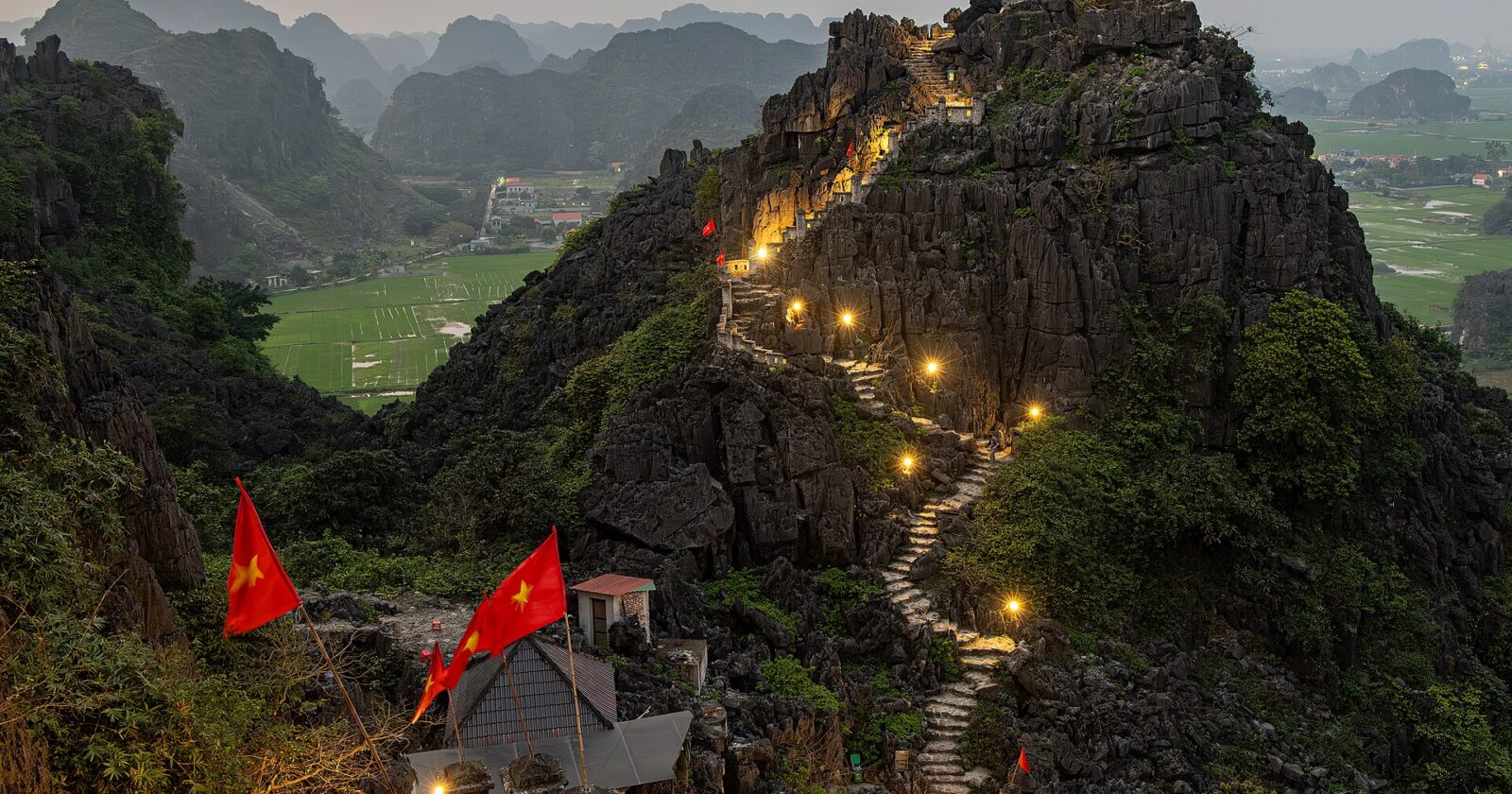
About two-thirds of the way up, many people stop. The stone steps have been climbing the ridge in tight zigzags, the rock on either side is sharp and grey, and the air has gone still and hot. Then you turn a corner, the ridge falls away, and below you is the Ngo Dong river, curling in an S through the Tam Coc rice fields between limestone towers that stretch to the horizon. It’s a picture you’ll have seen on many postcards, and you’re standing where it was taken. That moment, more than the cave or the summit, is the reason to climb Mua Cave Ninh Binh‘s best-known viewpoint.
This guide covers what’s at the top, what the climb is really like, sunrise against sunset (with sun times through the year), when the view is at its best, the ticket and how to get there, and who will find it hard. Details come from the provincial tourism centre and the Vietnam National Authority of Tourism, checked in November 2026. The ticket price is the one detail that varies between official sources, so confirm it before you go. For everything else in the area, see our Ninh Binh travel guide.
Mua Cave at a Glance
| What it is | A small cave at the foot of a limestone ridge, and a stone stairway to a viewpoint on top |
| Where | Khe Ha village, Ninh Binh province, a short ride from Tam Coc |
| Steps | Nearly 500 stone steps, by the provincial tourism centre’s count |
| At the top | A statue of Quan The Am (the bodhisattva of compassion), a stone dragon and a small pagoda |
| Ticket | 100,000 VND per person on the provincial tourism listings; the Trang An heritage board’s 2026 price list gives 150,000 VND. Confirm before you go. |
| Hotline | 0987 111 312 |
| Time needed | Allow time for the climb, the top and the walk down |
| Best time | Late afternoon into sunset, or early morning |
What Mua Cave Actually Is
The name is a little misleading. Mua Cave, Hang Mua in Vietnamese, is a real cave at the foot of the hill, but it’s small, and it’s not why most people come. What draws the crowds is the ridge above it, sometimes called Ngoa Long, the “Lying Dragon” mountain, and the long stairway that climbs its spine to a viewpoint over the karst.
The name comes from a legend. According to the provincial tourism centre, a King Tran enjoyed royal dance performances here, and the cave became known as Hang Mua, the “Dancing Cave”. It’s a nice story, and that’s how to treat it: a legend, not a record.
At the foot of the hill there’s a lotus pond with a wooden walkway, which makes a pleasant warm-up before the climb and is a popular photo spot in its own right when the lotus is in bloom.
The Climb
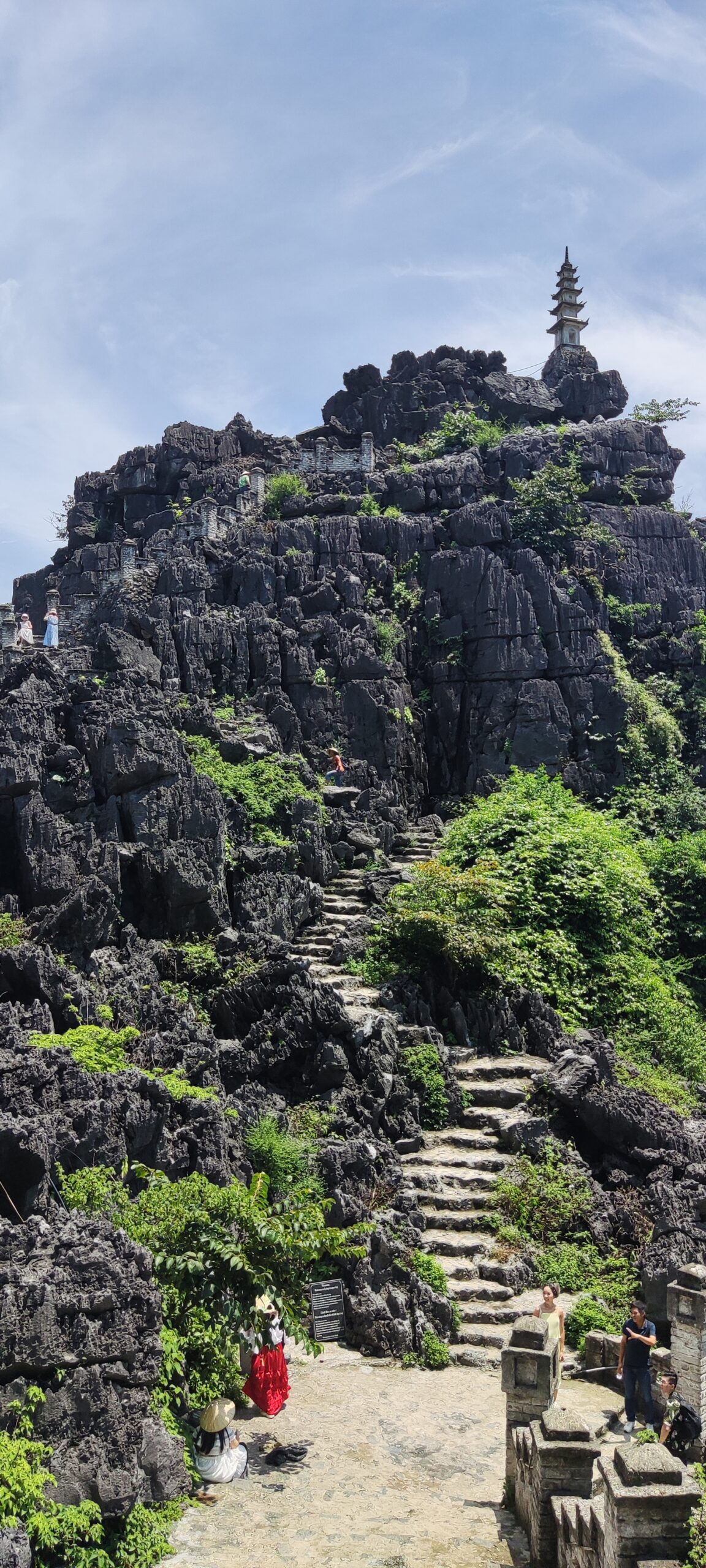
The provincial tourism centre counts “nearly 500” stone steps from the bottom to the top. In practice, they feel like more, because they’re not a smooth staircase. The steps are cut and laid into the rock in short flights, some deep, some shallow, winding back and forth up the ridge. There’s a stone balustrade along much of the way, and for the most part the path is wide enough for people to pass each other.
How hard is it?
For a reasonably fit adult it’s a short, steep effort: think of climbing the stairs of a tall building, in the heat, on uneven treads. It’s a short climb, but expect to stop for breath a couple of times on the way up. The difficulty is not length but heat and footing. There’s almost no shade near the top, and on a summer afternoon the rock radiates heat. After rain, the stone can be slippery.
- Children: Plenty of school-age children make the climb. Hold small hands near the top, where the rock is sharp and the drops are steep.
- Older visitors: Doable for most people who walk regularly, at their own pace. If you have knee trouble, the descent will be the harder part; a walking pole helps.
- Not for: anyone who can’t manage stairs without a handrail, or who has a serious fear of heights. The final section is a narrow, exposed rocky top.
What’s at the top
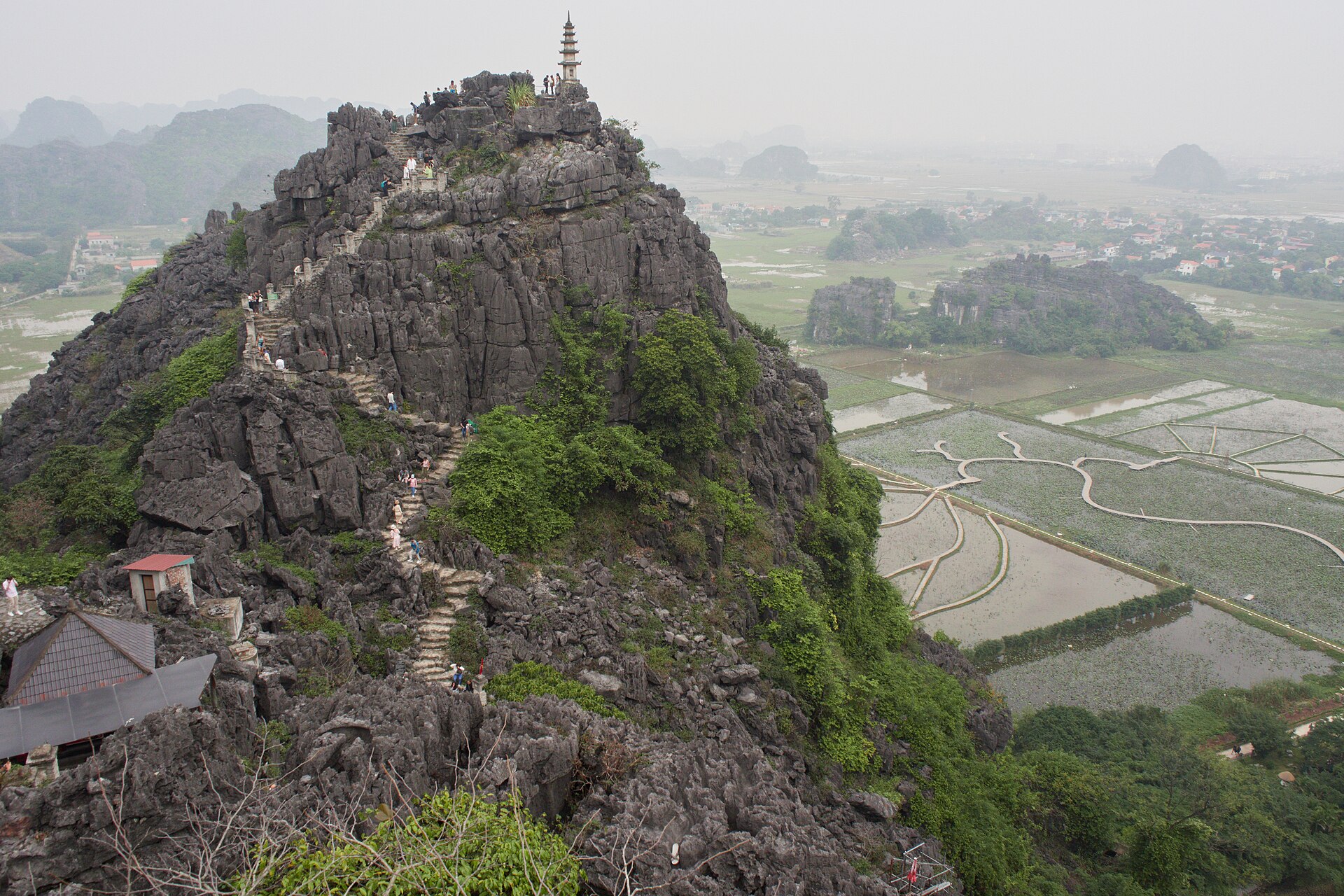
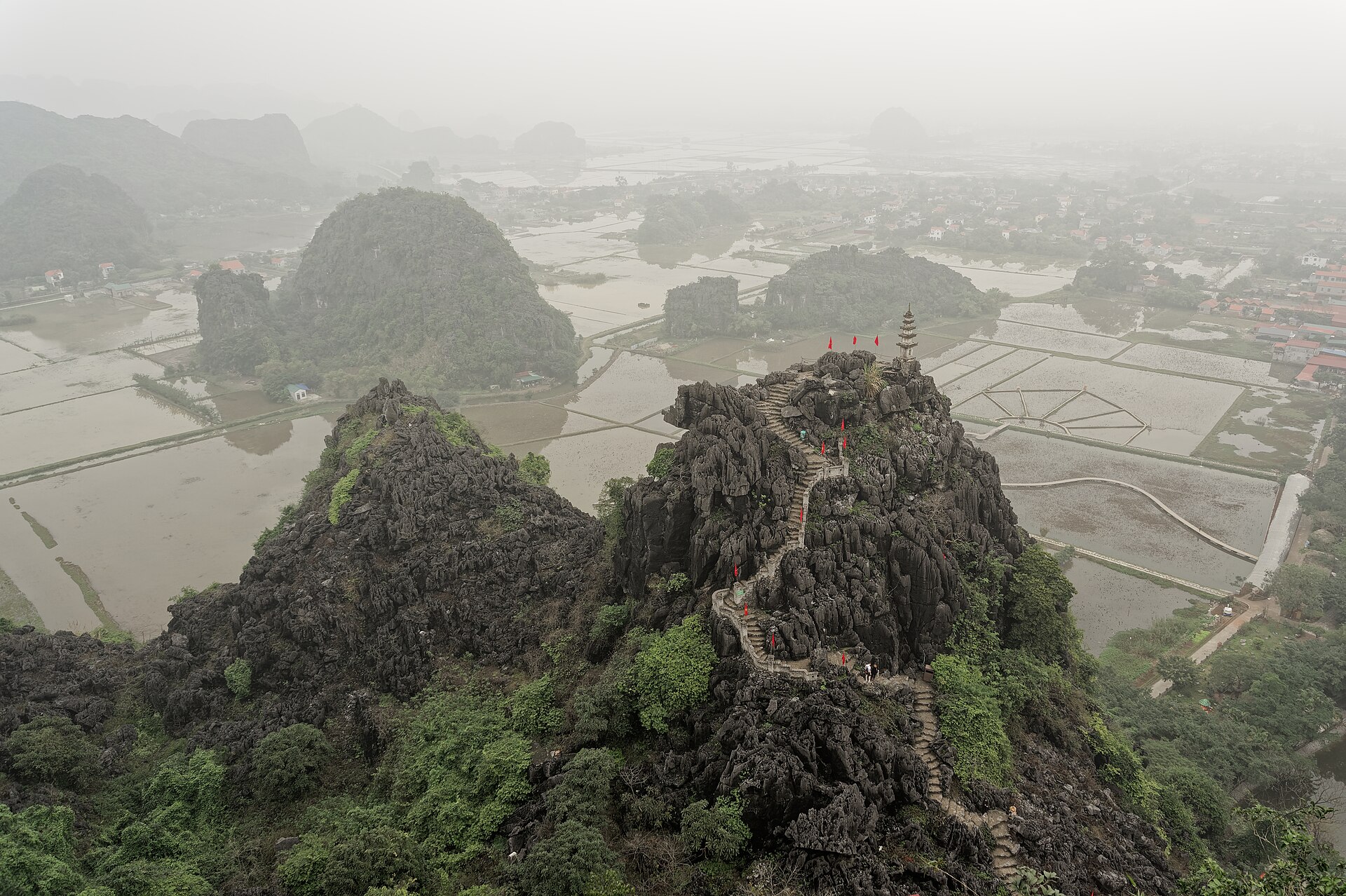
The provincial tourism centre lists three things at the summit: a statue of Quan The Am, the bodhisattva of compassion; a stone dragon sculpture; and a small Buddhist pagoda. The space around them is small, and the rocks are jagged, so watch your footing. This is where most visitors want their photo, and at sunset in high season there can be a queue for the best spots.
The View
Mua Cave’s view looks straight down on Tam Coc. The Vietnam National Authority of Tourism describes the climb as rewarded by views over the river, the rice paddies and the limestone peaks, and that sums it up. On one side, the Ngo Dong river bends through the fields between the cliffs, and you can often see the tiny shapes of the Tam Coc boats moving along it. On the other, the flat delta stretches away, dotted with isolated limestone hills. The provincial tourism portal says the summit takes in the whole Tam Coc–Bich Dong area and the surrounding delta.
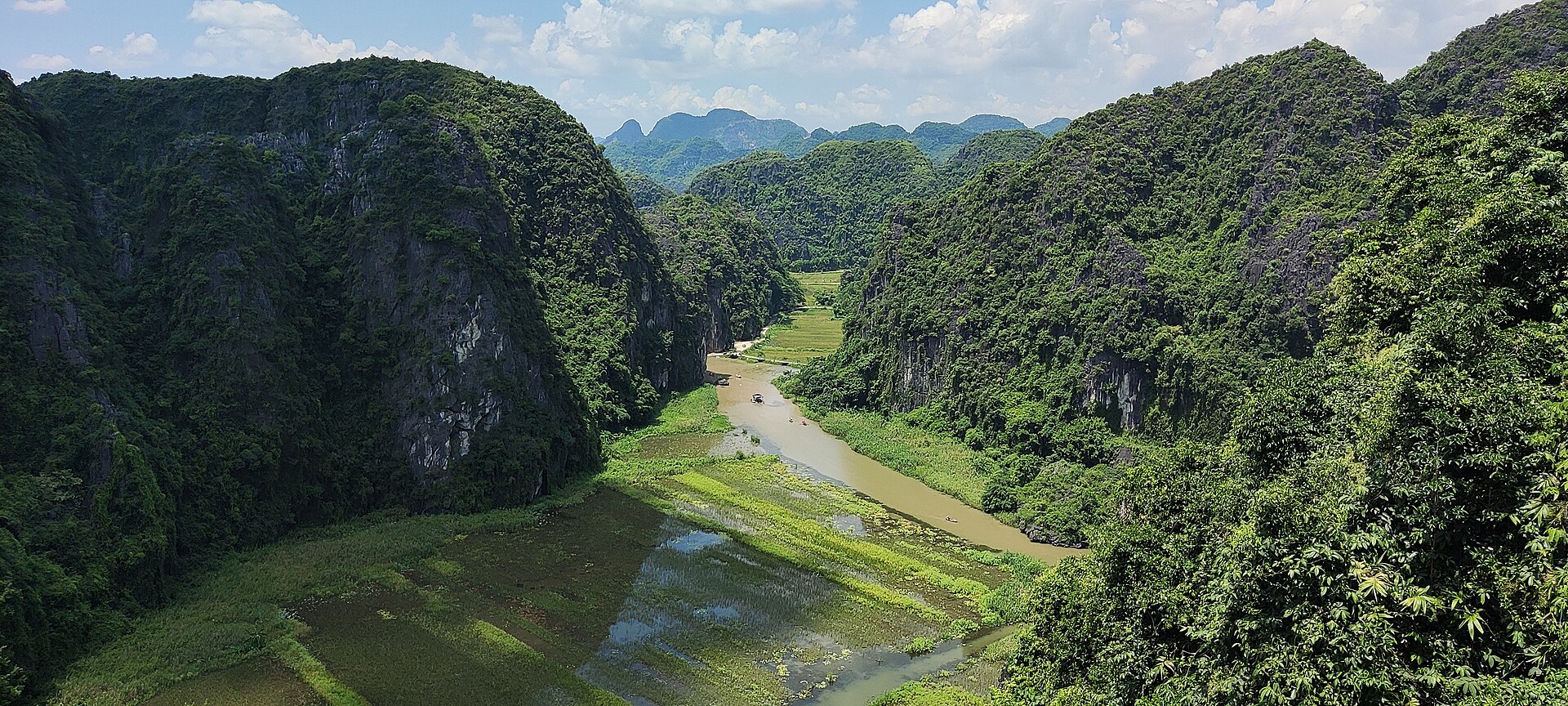
The view changes completely with the season. When the rice is high, the valley is bright green. When it ripens, around May, it turns gold. After the harvest, the fields go brown, then flood and are replanted, and in the cool months the karst often sits in a soft haze. All of these have their admirers, but the classic photo is of green or gold fields under a clear sky.
Sunrise or Sunset?
This is the main decision, and there’s no wrong answer.
Sunset is the popular choice. The light comes from the west, warm and low, and lights up the cliffs and the river below. It’s also easy to plan: you climb in the late afternoon, after a day on the boats, and walk down in the dusk. The provincial tourism portal suggests exactly this pattern: Trang An or Tam Coc in the morning, Mua Cave in the afternoon. The downside is that everyone else has the same idea, so the summit is crowded.
Sunrise is quieter, cooler and often misty, with the valley filling with low cloud or haze that burns off as the sun comes up. It suits photographers and anyone who’d rather avoid the crowds, but you need to be staying nearby, in Tam Coc or close to Mua Cave, and you’ll be climbing in the dark or half-light. Before you plan a sunrise climb, call the site’s hotline (0987 111 312) or ask your hotel to check what time the gate opens.
Sun times through the year
These are approximate times for Ninh Binh, in local time, around the middle of each period. Aim to be at the top 30 to 45 minutes before sunset, or set off in time to be there by sunrise.
| Time of year | Sunrise | Sunset |
|---|---|---|
| December–January | about 6:25–6:35 | about 5:20–5:35 pm |
| February–March | about 6:05–6:25 | about 5:55–6:05 pm |
| April–May | about 5:20–5:40 | about 6:15–6:25 pm |
| June–July | about 5:15–5:25 | about 6:35–6:40 pm |
| August–September | about 5:35–5:45 | about 6:00–6:25 pm |
| October–November | about 5:50–6:05 | about 5:15–5:35 pm |
The Best Time of Year
- Around May: the rice ripens and the Tam Coc valley turns gold. This is when many of the best-known photos are taken, and when the province has held a Tam Coc “golden season” festival. Expect heat and crowds.
- Summer: green, lush and hot. Climb early or late in the day, and expect sudden heavy showers that make the steps slippery.
- Autumn: often the most comfortable weather for the climb, although heavy rain still happens: Trang An’s boat tours and admission were suspended on 9 November 2026 because of heavy rain and strong wind.
- Winter: cool, often grey and hazy, with the fields bare or flooded. Comfortable for climbing, less vivid for photos, and very atmospheric on a misty morning. See our Hanoi in December guide for what the season is like in the north.
Whatever the month, weekdays are quieter than weekends, and Vietnamese public holidays are especially busy.
Tickets
The ticket price is the one detail that official sources don’t agree on. The provincial tourism centre’s page and the provincial tourism portal’s September 2026 cost guide give 100,000 VND per person. The Trang An heritage management board’s 2026 price list gives 150,000 VND. Bring enough cash for the higher figure, and if the exact price matters to you, check with the hotline (0987 111 312) or your hotel.
You pay at the gate at the foot of the hill. Bring cash; small notes are easiest.
Getting There
From Tam Coc village: Mua Cave is a short bicycle or motorbike ride from Tam Coc along the lanes through the fields, and it’s the easiest base. Most hotels and homestays in Tam Coc lend or rent bicycles, and the ride is part of the pleasure.
From Ninh Binh city: take a taxi or a Grab, or hire a motorbike. Motorbike rental in the area runs from about 100,000 to 150,000 VND a day, according to the provincial tourism portal.
From Hanoi: Ninh Binh is about 90 to 100 km south of Hanoi, and the provincial portal puts the bus at 1.5 to 2 hours. To see Mua Cave at sunset on a day trip, you’ll need a car and driver, so that you aren’t tied to a tour group’s or a bus’s return time. Our Ninh Binh day trip guide covers the options. It’s much easier to do Mua Cave well with a night in Tam Coc.
Combining Mua Cave with Tam Coc and Bich Dong
Mua Cave sits right above Tam Coc, and the three make a natural half-day or day together. A good plan if you’re staying in Tam Coc:
- Morning: the Tam Coc boat trip (about two hours), as early as you can, when the river is quieter.
- Midday: lunch in Tam Coc village, then a rest through the heat.
- Afternoon: cycle to Bich Dong Pagoda, a pagoda in three levels set into the cliff.
- Late afternoon: cycle to Mua Cave and climb for sunset. Then look down on the river you were rowed along in the morning.
If you’re torn between the two boat trips, our Trang An vs Tam Coc comparison sets out the differences. Trang An is about 20 minutes from Tam Coc, so a Trang An morning and a Mua Cave sunset also work well.
Taking Photos at the Top
The summit of Mua Cave is small, so a little planning goes a long way.
- Get there early. At sunset, the best ledges fill up well before the light turns gold. Arrive 30 to 45 minutes before sunset and you’ll have time to find a spot and catch your breath.
- Think wide. The classic shot of the river bending through the fields needs a wide angle. A phone’s ultra-wide lens works well. A longer lens is useful for picking out boats on the river or the pagoda on the summit from lower down.
- Use the stairway. Some of the best pictures aren’t from the very top but from the stairway on the way up, looking back at the pagoda and the stone dragon with the fields behind.
- Mind your footing. The rock at the top is sharp and uneven, and the drops are real. Don’t step backwards while framing a shot, and keep children close.
- Tripods. There’s very little flat space on the summit, and a tripod can block the way on a busy evening. A small one, or a ledge to rest the camera on, is more practical.
- Drones. Rules on flying drones in Vietnam are strict, and heritage areas have their own restrictions. Check the current rules and ask at the gate before you fly.
For more photo spots in and around the city, see our Hanoi photography itinerary.
Where to Stay Near Mua Cave
To do Mua Cave at sunrise or sunset without rushing, stay close by. Tam Coc village is the obvious base: it has the most homestays, small hotels, cafés and bike rental, and Mua Cave and Bich Dong are both an easy cycle away. There are also homestays and small resorts out among the fields between Tam Coc and Mua Cave, and on the quieter Trang An side, which suit anyone who wants a peaceful night and has transport.
The provincial tourism portal’s September 2026 guide puts budget double rooms at about 250,000 to 500,000 VND a night, 2–3 star hotels at about 600,000 to 1,200,000 VND, and resorts near Trang An from around 2,000,000 VND. Our Ninh Binh travel guide compares the areas in more detail.
What to Bring
- Water. More than you think you need, especially from April to September.
- Proper shoes. Trainers or walking sandals with grip. Flip-flops are a bad idea on worn, uneven stone.
- Sun protection. A hat and sun cream. There’s little shade at the top.
- A torch or headlamp if you’re climbing for sunrise or staying until after sunset.
- Cash for the ticket and a drink at the bottom.
- Modest clothing if you want to look closely at the statue and pagoda at the top: shoulders and knees covered is respectful at religious sites in Vietnam. See our guide to Vietnamese customs.
- A light layer for a winter sunrise; it can be chilly at the top before the sun is up.
Is Mua Cave Worth It?
Yes. If you climb one thing in Ninh Binh, make it this one. The view over Tam Coc is a great one, and it’s earned with a short climb, not a day’s hike. It’s the place that makes sense of the whole landscape: from the top you see how the river, the fields, the villages and the limestone towers fit together.
The honest drawbacks are the crowds at sunset in high season, the heat in summer, and the fact that the “cave” in the name is an afterthought. Go early or late, take water, and give yourself time at the top.
Mua Cave FAQ
How many steps are there at Mua Cave?
Nearly 500, according to the provincial tourism centre. They’re uneven stone steps in short, steep flights, with a balustrade along much of the way.
How long does it take to climb Mua Cave?
It’s a short climb for most reasonably fit people, with a couple of stops for breath. Allow time for the climb, the top and the walk down.
How much is the Mua Cave ticket?
The provincial tourism listings give 100,000 VND per person, and the Trang An heritage board’s 2026 price list gives 150,000 VND. Bring cash for the higher figure, and confirm on the hotline (0987 111 312) or with your hotel.
Is sunrise or sunset better at Mua Cave?
Sunset is more popular and easier to plan, with warm light on the cliffs; sunrise is quieter, cooler and often misty. For sunrise, check the gate’s opening time first.
Is the Mua Cave climb hard?
It’s short but steep, on uneven stone, and hot in the middle of the day. Most people who can manage a few flights of stairs can do it at their own pace. It’s not suitable for people who need a handrail all the way or has a serious fear of heights.
When is the best time of year to visit Mua Cave?
Around May, when the Tam Coc rice turns gold, for the classic view. Autumn is often the most comfortable for the climb. Winter is cool and hazy.
How do I get to Mua Cave from Hanoi?
Ninh Binh is 90 to 100 km south of Hanoi, about 1.5 to 2 hours by bus. Mua Cave is a short ride from Tam Coc village. For a sunset visit on a day trip, use a car and driver; it’s easier with a night in Tam Coc.
Planning the Rest of Your Ninh Binh Trip
Mua Cave is one piece of a Ninh Binh visit. Our Ninh Binh travel guide covers the boat trips, Hoa Lu, Bai Dinh and where to stay, and the Trang An vs Tam Coc comparison helps you choose your boat trip.
The boats you can see from the summit, moving along the Ngo Dong river below, are on the Tam Coc boat ride. Our Tam Coc boat ride guide covers the tickets, the three caves, the tipping question and the best time of year to go.
Related Hanoi Guides
- Ninh Binh Travel Guide
- Trang An vs Tam Coc
- Ninh Binh Day Trip from Hanoi
- Day Trips from Hanoi
- Hanoi Photography Itinerary
- Hanoi Adventure Activities
- 7 Days in Hanoi and Northern Vietnam
Photo Credits
Featured image, the lit stairway to the summit at dusk: 2024-03-30-Mua Cave Dragon Mountain-3758 by Superbass, CC BY-SA 4.0, via Wikimedia Commons.
The upper stairway: Hang Mua 7 by Shyamal, CC BY-SA 4.0, via Wikimedia Commons.
The summit ridge and pagoda: Ninh Binh – NinhBinh1648 by lumoplank, CC0, via Wikimedia Commons.
The view over the river and fields: View from Hang Mua 2 by Shyamal, CC BY-SA 4.0, via Wikimedia Commons.
Morning haze over the summit and fields: Mua Cave, Ninh Binh, Vietnam, 20240202 0926 4964 by Jakub Hałun, CC BY 4.0, via Wikimedia Commons.